I’ve been curious about the FEW Spirits brand since the day I ran across a bottle of their bourbon in a store in Nashville. They are a relatively new distillery, but have made quite a name for themselves. In addition to gin and seasonal products, FEW Spirits distills white whiskey, rye whiskey and bourbon in their Evanston, Illinois distillery. Their bottles are adorned in art that pays homage to the 1892 Chicago World’s Exposition. Founder and Master Distiller Paul Hletko was kind enough to answer a few questions about FEW Spirits via email.
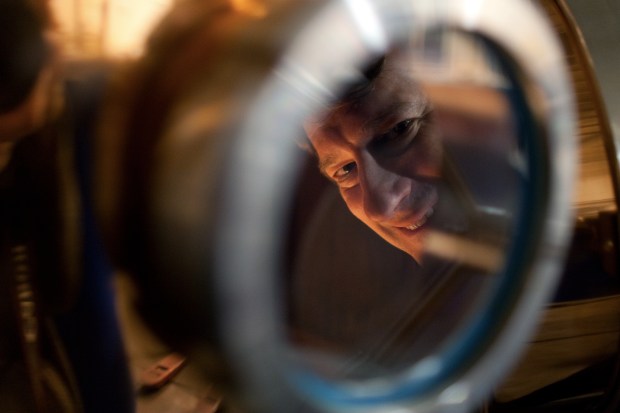
Photo courtesy of FEW Spirits
Paul, thanks for taking to time to answer a few questions for AdventuresInWhiskey.com. Let’s start things off with your commitment to be a true craft distiller. You guys are a true grain-to-glass producer, which I assume is much more costly than buying stocks of whiskey.
Frankly, it’s not even close. We are passionate about what we do and how we do it, so it’s an investment we are happy to make, but it does add challenges. On the other hand, it also allows us to make different products than everyone else, because we have full control over every aspect.
What does FEW stands for?
The name “Few” is intended to evoke the fact that we don’t make a lot, and rather, just make a little. Or a Few. We also like the fact that folks who enjoy their alcohol in moderation can have just one drink and also make it a Few. There are several out there who also enjoy the sheer coincidence that the second head of the Women’s Christian Temperance Union (WCTU), who lived here in Evanston, was named Frances Elizabeth Willard, initials F.E.W. But that’s a coincidence.
Your distillery is located in Evanston, IL, which was in a formerly dry county. That changed fairly recently, but you still had a lot of work to do before you were able to start distilling there.
Absolutely. Evanston was founded as a dry community in the 1850s, and the WCTU has had a major role in local and national history. (Indeed, Frances Willard was the first woman memorialized in statue form in the rotunda of the US Capitol.) Alcohol was banned entirely in Evanston until 1972. But when I wanted to start the distillery, the city of Evanston was extremely supportive, and has been great to work with ever since. Honestly, any difficulties we ran into were because nobody had ever dealt with a distillery before and not because of any opposition to it.
In terms of labeling, you went with something important to the growth of the Chicago area – the 1892 Chicago World’s Exposition. Why that choice?
The World’s Fair was a major event in Chicago history and is even the inspiration for one of the 4 stars on the Chicago flag. We like it, as it allows people that recognize it to understand that we’re saying Chicago, without actually saying it. Also, Frances Willard was a featured speaker at the Fair, as she was one of the most famous women (and Evanston residents) in the world at the time.
You weren’t always in the whiskey business. Tell us a little bit about where/how you started, and what led to your current path?
I’ve always been motivated by creativity. Creativity is what motivates me. I’ve been a musician, and ran a record label. I’ve been a homebrewer, and designed and built custom guitar effects pedals. I was led to distilling by, not only a passion for spirits, but also a family history. Prior to WWII, my grandfather’s family owned a major brewery in what is now the Czech Republic. After the Nazi invasion, they no longer owned the brewery, and although my grandfather survived the camps, the rest of the family was wiped out. My grandfather never recovered the brewery, and when he died, I wanted to build on that family history but do something new and positive.
Craft distilleries generally aren’t known to release whiskies older than a couple of years because of costs. What’s the average age of your rye and bourbon? Any plans to release something in the 6+ age range in the future?
I don’t believe in age statements, as there is much more to whiskey than just age in barrel. Obviously, time in barrel is a very important factor, and cannot be ignored, but there are many other factors, ranging from ferment time and temperature, to the depth of heads and tails cuts (if making cuts at all), to the distillation proof. Because we don’t believe in age statements, we don’t use them.

Photo courtesy of FEW Spirits
You’re currently being distributed in 12 states I believe. Any word on when we’ll get to see some of your spirits down here in Louisiana?
We are hoping to come down to Louisiana in 2015, actually. We’ve had a lot of interest, and we’re excited to be there.
Few Spirits has gotten a lot of great press lately, including having your rye whiskey being named “Craft Whiskey of the Year” by Whisky Advocate. Considering all the awards and success, what are you most proud of?
I’m most proud of the team we have at Few, and what we’ve been able to do. We love the spirits we make (we wouldn’t make them if we didn’t!), but the team is the key.
When you’re not drinking your own product, what are some of your go-to whiskies on the market?
There are some amazing whiskies on the market, for sure. My favorites can change depending on mood, but currently, I’ve been enjoying Four Roses, Westland, Balcones, and Corsair.
What’s your favorite whiskey cocktail?
I drink whiskey neat, typically, but can often be found enjoying a Manhattan.
 Adventures In Whiskey