whiskey review

Eagle Rare 17 Year Old Bourbon Whiskey (2014) Review

IMG_2750

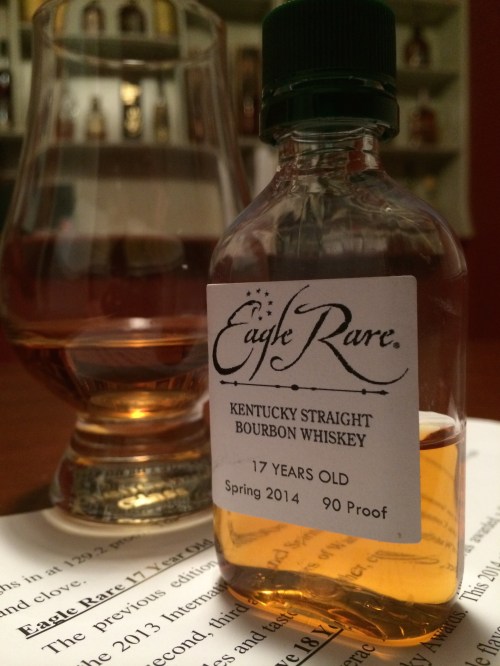
Buffalo Trace releases two bourbons that carry the Eagle Rare name:  an almost readily available 10 year old version and this 17 year old entry in the Antique Collection.  Bourbon enthusiasts who prefer lower proof bourbon may reach for this before going for a much higher proof George Stagg or William Larue Weller.  Buffalo Trace provided a review sample.

This one’s really nice.  I get mostly caramel and oak, but not too much oak, when I smell this.  Taste-wise, I get some oak, some spices (cinnamon and a little nutmeg) and caramel.  It’s buttery:  not in the flavor, but the way it feels.  The finish is a little spicy, bittersweet, and a little dry (probably because of the oak).

I liked the 10 year old the last couple of times I drank it.  It’s great for the <$30 price tag.  Eagle Rare 17 year old is an outstanding boubon.  Elegant and refined, it keeps the oak in check.  Price-wise, this will set you back $80.  If you’re looking for an occasional special sipper, this one is worth checking out.

UPDATE:  According to Buffalo Trace’s fact sheets, this year’s Eagle Rare 17 year old bourbon is actually 19 years old.  There were only 26 barrels of this bourbon batched for this release, making Eagle Rare 17 along with Sazerac 18 the rarest of this year’s collection.
9/10

William Larue Weller Bourbon Whiskey (2014) Review

IMG_2745

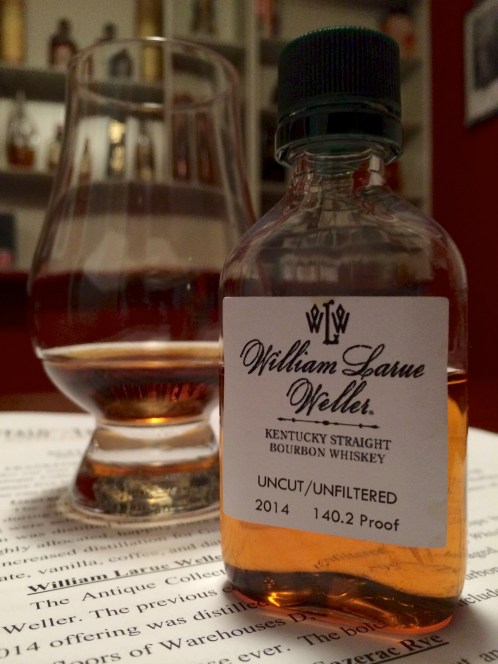
William Larue Weller is the only wheated bourbon in the Buffalo Trace Antique Collection.  In essence, this is a barrel proof W. L. Weller 12 year old, which is not a bad thing.  I’m sure this release gets choice barrels from the W. L. Weller line of whiskies.  A wheated bourbon means wheat is used as the flavoring grain instead of the more common rye.  Maker’s Mark and the Van Winkle bourbons are all wheated bourbons.  Mr. Weller is credited with being the first distiller to use wheat instead of rye for bourbon back in the mid-1850s.

This year’s release of William Larue Weller is a hellish 140.2 proof.  That’s the highest proof this bourbon’s ever been.  It’s even higher than this year’s George T. Stagg… if only by a couple of proof points.  Buffalo Trace Distillery provided a review sample.

When I take a nice big whiff of this bourbon, I get lots of alcohol and caramel.  When I take a smaller whiffs, I get LOTS of caramel and toffee, as well as a little oak.  Tasting it there’s a lot of sweet caramel, baking spices like cinnamon and cloves, and toffee.  The finish is sweet and dry.  While the high proof does come into play in terms of spice and heat, I find it slightly more palatable to drink neat when compared to George T. Stagg.  Adding water to this calms down the heat and really brings out the sweetness.

Make no mistake, this is one delicious bourbon.  Being a member of the Buffalo Trace Antique Collection means it’ll be very hard to find in stores.  If the planets align and you run across a bottle, pick it up for the $80 suggested retail price.

9/10

George T. Stagg Bourbon Whiskey (2014) Review

IMG_2742

Every fall Buffalo Trace releases their Antique Collection comprised of three bourbons (George T. Stagg, William Larue Weller, and Eagle Rare 17 Year Old) and two rye whiskies (Sazerac 18 Year Old and Thomas H. Handy Sazerac).  They range in age from 6 or so years to 18, and three of them are barrel proof.  These five whiskies are coveted among American whiskey fans.  George Stagg and Sazerac 18 are almost always at the top of “best of” whiskey lists each year.  Lately, hype surrounds certain bourbons (Pappy, anyone?), and these five whiskies are no exception.

This year’s George T. Stagg was distilled in 1998, making it 16 years old.  It comes to us “uncut & unfiltered” at a hearty 138.1 proof.  If you’re used to only drinking 80 or 90 proof bourbon, this number looks astronomical.  The strongest Stagg release was back in 1997, which saw a 144.8 proof bourbon.  Yikes!  I like sipping neat first, then adding a little water if I need it.  Most times I don’t.  This time I kept it close-by. Buffalo Trace Distillery provided a review sample.

This stuff smells nice.  I got alcohol fumes, caramel, toasted oak, and a little citrus.  Tasting it (slowly), I find it’s one of the thicker whiskies I’ve had.  Could be due to the high proof.  I got lots of toffee, butterscotch, cinnamon, a little oak and some vanilla.  There was also a little bitterness.  Buffalo Trace’s included tasting notes mentioned dark chocolate.  That may be the best way to describe the bitterness.  Now, don’t go expecting a Hershey bar here.  The finish was long and bittersweet.  The heat fades after a few sometimes intense spicy moments.  I tasted about half the glass neat, then added a minuscule amount of water.  The water slightly calmed down the heat and spaced the flavored out a bit.

The suggested retail price for the whiskies in the Antique Collection is $80.  Anything higher than that and your store is gouging your wallet.  I spoke about whiskey hype earlier in the post.  This one lives up to whatever hype it receives.  Drinking George T. Stagg is a truly sensory experience.  Don’t pass up a chance to purchase a bottle (at a reasonable price).  Your taste buds will thank you.

9.5/10