What’s Tennessee Whiskey?

Over the course of the next several weeks, I’m diving head first into Tennessee Whiskey.  There are two giants in the Tennessee whiskey world:  Jack Daniel’s and George Dickel.  I’ll be looking at several of their offerings, and next week I’ll post an interview I recently conducted with Jack Daniel’s Master Distiller Jeff Arnett.  To kick things off, let’s answer the question:  what’s Tennessee whiskey?

Tennessee whiskey has been made with pretty high standards for well over a hundred years, but it wasn’t until recently that it was put into law. In April of 2013, Tennessee passed house bill #1084 into law.  That bill defines rules for a spirit to be called Tennessee whiskey.  There are seven of them.  To be called Tennessee whiskey, a spirit must be:

  1. Manufactured in Tennessee;
  2. Made of a grain mixture that is at least fifty-one percent (51%) corn;
  3. Distilled to no more than 160 proof or eighty percent (80%) alcohol by volume;
  4. Aged in new, charred oak barrels in Tennessee;
  5. Filtered through maple charcoal prior to aging;
  6. Placed in the barrel at no more than 125 proof or sixty-two and one half percent (62.5 %) alcohol by volume; and
  7. Bottled at not less than 80 proof or forty percent (40%) alcohol by volume.

These are the same rules distillers must follow when making bourbon, with a couple of exceptions:  Bourbon can be made anywhere in the United States and doesn’t have to be filtered with maple charcoal prior to aging.  The maple charcoal filtering is generally referred to as the Lincoln County process.  At one point the Jack Daniel’s distillery was located in Lincoln County, TN.  County lines were redrawn and it now resides in Moore County.  The process refers to drip filtering new distillate through maple charcoal (like Jack Daniel’s) or steeping the maple charcoal in vats of the new distillate (like George Dickel).  It’s said this kind of filtration removes the harshness of the new spirit.  Critics say it removes some of the flavor and body of the spirit.

Another difference is that to be called bourbon, a spirit must age at least two years in the barrel.  Tennessee whiskey rules do not cover minimum aging.  However, most Tennessee whiskey out there is aged at least two years, and can technically call themselves bourbon whiskey.

Now Tennessee whiskey is an official sub-sect of American whiskey, along with bourbon and rye. If you haven’t tried Tennessee whiskey beyond Jack Daniel’s Old No. 7, please do so.  That’s just one expression of Tennessee whiskey.  Like bourbon, Tennessee whiskey ranges in flavor between expressions.  You’re still reading?   Get out there and taste some Tennessee whiskey!
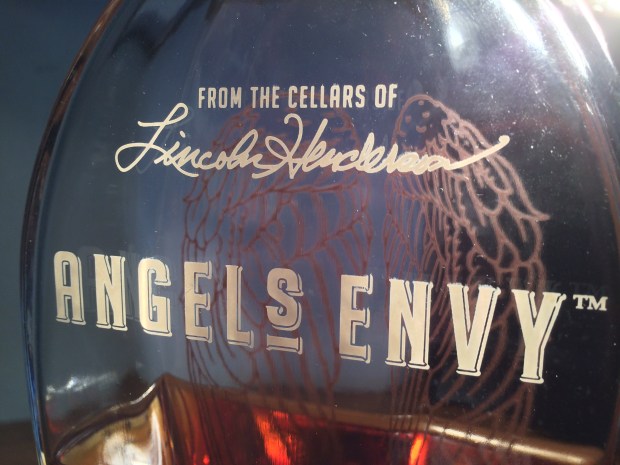
 

Angel’s Envy Bourbon Review

IMG_2126

I’ve been reading about Angel’s Envy bourbon since it was first released a couple of years ago.  Several weeks ago, I asked the folks at Ro-Bro Marketing for a review sample of Angel’s Envy Rye.  Along with a sample of the rye, they sent a sample of Angel’s Envy Bourbon.   It’s now available in the New Orleans market where I’m based, but it wasn’t a year ago.  On my way back from a road trip to Chicago (I just had to see the Rolling Stones live), I made a detour to Memphis.  The reason, Angel’s Envy was sold in that market.  I picked up a bottle and I’m glad I did:  it quickly became one of my favorite bourbons.

Angel’s Envy is a play on an old distillery term “the angel’s share,” which referred to whiskey that evaporated over time.  If the evaporated whiskey was the angel’s share, what was left in the barrel was their envy.  Angel’s Envy was started by Wes Henderson, whose father Lincoln Henderson was a big name in the American Whiskey industry.  While he worked at Brown-Forman, he helped with the development and launch of Jack Daniel’s Single Barrel and Woodford Reserve – two whiskies I really enjoy.  He came out of retirement to help his son with Angel’s Envy, and I’m glad he did.  They sourced bourbon and finished it in port wine barrels for several months.  Sadly, Lincoln passed away last year.

IMG_2386      IMG_2124

The first thing you’ll notice is the bottle.  Its sexy curves and angel’s wings print make for one of the best looking bottles on the shelf.  There’s a really nice sweet caramel aroma.  When I taste this one, I get sweet caramel and toffee, a little vanilla, and a little spiciness (think cinnamon instead of cayenne pepper).   A little berry too, and that’s probably from the port cask.  It’s lush and velvety, but not syrupy.  The sweet and slightly spicy finish slowly fades away.

The idea of finishing bourbon in port wine barrels intrigued me enough to buy a bottle.  It does add a sweet berry quality to the bourbon, and further refines it.  This bourbon is easily drinkable, and I’ve recommended it to anyone who listens.  It’s 86.6 proof and runs about $45 – $50.

Highly recommended.

9/10

Father’s Day Gift Guide

Father’s Day is right around the corner.  If you’re like me, sometimes you just don’t know what to get dad for Father’s Day.  There’s no better gift for dad than a nice bottle of bourbon.  Doesn’t have to be expensive.  Here are five bourbons that are available on the shelves and won’t break the bank.

Under $25

  1. Elijah Craig 12 Year  This is not a solid bourbon for the price.  This is a solid bourbon, period.
  2. W. L. Weller 12 Year   Loads of flavor in this complex wheated bourbon.

$30 – $50

  1. Four Roses Small Batch  A lighter style bourbon with lots of character.  Never had a bad glass.
  2. Angel’s Envy Bourbon  A light yet complex bourbon.  This was finished in a port wine barrel.  One of my favorites.
  3. Booker’s Bourbon   An uncut, unfiltered barrel proof bourbon.  In my opinion, the best of the Jim Beam lineup.