And Then There Was Kilchoman

Cask No. 1 in the warehouse at Kilchoman Distillery. Photo courtesy of Kilchoman.

Cask No. 1 in the warehouse at Kilchoman Distillery. Photo courtesy of Kilchoman.

The Kilchoman distillery is the new kid on the Islay block.  Built in 2005, it’s the first distillery built on the Scottish island in over 120 years.  Their first distillate was barreled later that year.

One interesting thing about Kilchoman is that it’s built on a farm, and grows about a third of its own barley.  The rest comes from Islay’s Port Ellen Maltings.  Their website (see link at bottom of this post) lists so much information about the distillation process it will leave a smile on every whisky enthusiast.

Kilchoman whiskies feature no chill-filtering and natural color.  Since the distillery was founded in 2005, clearly none of their whisky is older than 10 years old.  In fact, most are between 3 (the minimum aging to be called Scotch whisky) and 7 years old.

Machir Bay

Photo courtesy of Kilchoman

Photo courtesy of Kilchoman

Named after a beach close to the distillery, Machir Bay is Kilchoman’s core expression.  It’s aged in a combination of bourbon and sherry casks, which is unusual as most of Kilchoman’s whiskies are aged in bourbon casks.  Machir Bay is bottled at 92 proof.

Right off the bat, there’s some fat peaty smoke.  But there’s much more to the nose.  Bold tropical fruit and honey add sweetness, while the bourbon barrel maturation give a bit of vanilla and spice.  All the aromas carry over to the palate.  Bright citrus, smoked fruit and a candy-sweet toffee are the big flavors here, and they work together beautifully.  The finish is a bit on the hot side, probably due to the whisky’s youngish age (there’s no age statement on this whisky).  That continuing theme of sweet smoky fruit continues through the long finish.

I have a soft spot for peated whiskies that are fully or partially matured in ex-sherry casks.  There’s something about that smoked fruit note I enjoy.  Machir Bay is a fantastically rich, sweet and smoky release from Kilchoman.  Recommended!

8/10

100% Islay 5th Edition

Photo courtesy of Kilchoman

Photo courtesy of Kilchoman

Everything about this whisky is Islay.  The barley is grown and malted on Islay.  The water is from Islay.  It’s distilled and aged in Islay.  You get the picture.  This Kilchoman expression is bottled at a hearty 100 proof.  The company’s website states the peat levels here are lower than their other expressions.

Kilchoman 100% Islay is sharper, crisper and overall lighter than Machir Bay.  The nose is all lemon peel and barley grain, with an undertone of smoke.  It’s not a heavy smoke.  Rather, it’s light and helps carry the bright citrus forward.  I also get just a little sweet fruit in the background.  The entry doesn’t have the initial hit of alcohol I expected for a 100 proof whisky.  Instead, the burn slowly develops as Lemonhead candy, grain and light peat in the form of grass quickly become the dominant flavors.  I detect some vanilla towards the end of the mid-palate.  The finish is a little hot, but leaves behind a sweet grain note.

I appreciate what Kilchoman was going for here, but I’m not a huge fan.  It feels a bit too young for my own taste.  That doesn’t mean it’s a bad whisky.  I think it’s the beginning of what could be an outstanding release in a few years.

7.5/10
(Note: Review samples were provided by Impex Beverages.)

Laphroaig Triple Wood & 18-Year-Old Single Malt Scotch Whisky Reviews

Photo courtesy of Laphroaig.

Photo courtesy of Laphroaig.

Readers of this blog know I’m a huge fan of Laphroaig whiskies.  I’ve enjoyed every expression of Laphroaig, except for their Select release.  I found that one to be a bit underwhelming.  So, when I decided to post a series of Islay whisky reviews, including Laphroaig was a no-brainer.  To this point, I’ve reviewed every core expression of Laphroaig except for the 18-year and the Triple Wood.  Let’s fix that.

Triple Wood

Photo courtesy of Laphroaig.

Photo courtesy of Laphroaig.

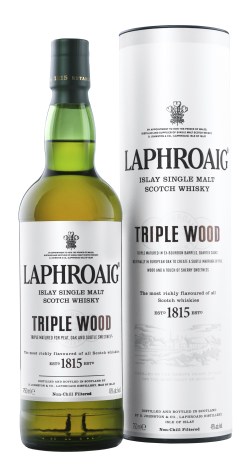
As the name suggests, this expression of Laphroaig is triple-matured.  The first maturation takes place in ex-bourbon barrels.  After an undisclosed amount of aging (after all, this IS a non-age stated whisky), the liquid is moved to smaller quarter casks for its second maturation.  After some time, the whisky is transferred again to European oak casks that previously held Oloroso sherry.  This release is non-chill filtered and bottled at a hearty 48% abv.

The nose is full of rich smoked fruit, caramel and peat, with some oak in the background.  The fruity aromas make sort of reminds me of a sweeter, younger sibling to Laphroaig 15 year old.  Taste-wise, oak is a major player – just as it is in Laphroaig Quarter Cask – and shows up immediately on the entry.  Sweet tropical fruit and toffee provide sweetness and richness to the whisky.  But, this is Laphroaig, so that signature ashy smoke and brine is here as well, though that salty note is a bit subdued.  Vanilla bean and a touch of wine pop up towards the end of the mid-palate.  The finish is a little hot at first, but fades over a long time and leaves behind smoked tropical fruit.

Laphroaig distillery manager John Campbell has concocted a rich, sweet and smoky whisky with Triple Wood.  There’s great precision in the use of ex-sherry casks for this release.  The sweetness the sherry cask-maturation provides gives this whisky extra layers of complexity and overall enjoyability.  Highly recommended.

8.5/10

Laphroaig 18-Year-Old

Photo courtesy of Laphroaig.

Photo courtesy of Laphroaig.

The general rule of thumb is that peated whiskies lose their “peatiness” the longer they mature.  Laphroaig’s standard 10-year-old expression is a peaty slap in the face.  Let’s see what eight extra years of maturation does to the “smoky beast”.

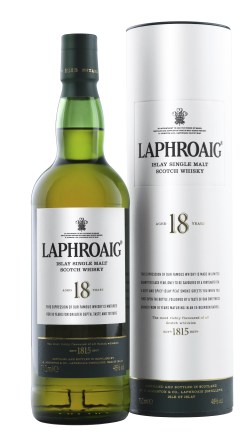
On the nose is a bit of sweet, almost candy-like fresh fruit (honeydew melon and pineapple) and vanilla, alongside soft peat and honey.  Though it’s bottled at 48% abv, the entry is rather mellow.  Those saccharine fruit notes from the nose are also found on the palate.  Toffee lends a bit of richness (and sweetness) on top of smoky vanilla and just a touch of spiciness.  The peat comes across as a grassy note.  Some citrus (I’m torn between lemon peel and grapefruit) develops into the long, sweet and somewhat smoky finish.

Eighteen years in oak did mellow the peat Laphroaig is famous for.  Though this expression is still richly flavored, the peaty punch has changed from an knock-out uppercut to a strong right hook.  It still tastes like a Laphroaig whisky, just not as sweet or smoky.  Let’s call it refined.  I liked this whisky a lot the first time I tasted it.  I liked it even more upon further sampling.  Highly recommended, so long as you’re not expecting a giant peaty beast.

9/10
(Note: Review samples were provided by Laphroaig.)

Lagavulin 16-Year-Old Single Malt Scotch Whisky Review

Photo courtesy of Diageo

Photo courtesy of Diageo

Lagavulin is Diageo’s smokiest Islay whisky.  It’s certainly a favorite of Nick Offerman, who is the distillery’s current celebrity ambassador.  You can watch ten hours (yes, 10 hours) of Nick Offerman drinking Lagavulin 16-year Scotch in front of a burning yule log.

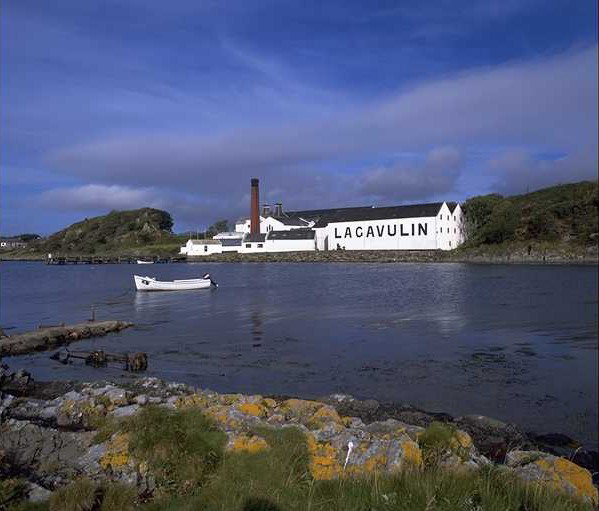
The distillery has been around legally since 1816, which makes 2016 it’s 200th anniversary.  It’s located close to Islay town of Port Ellen, which also was home to the legendary distillery.  That distillery closed its doors in the early 1980s.

Photo courtesy of Diageo

Photo courtesy of Diageo

Lagavulin’s core expression is a 16-year-old single malt.  The nose is rich, sweet and smoky.  I’d describe it as smoky first and peaty a distant second.  A strong orange rind note is also present, along with a touch of seaweed.  Toffee adds sweetness on the nose and the palate.  The entry is surprisingly not as sweet as the nose lends me to believe.  Smoke, brine and an herbal note start things off.  There’s a bit of peat here, but again, it seems to be a small contributor.  A nice burned orange peel and tropical fruit show up on the back palate.  The ashy smoke finish is long.  Even though it’s bottled at 43% abv, Lagavulin 16-year feels slightly anemic in terms of mouthfeel.

I like Lagavulin 16-year.  It’s richer, smokier, and heavier in character than it’s Islay cousin, Caol Ila.  Even better is the limited edition 12-year-old expression of Lagavulin.  I’ll give that yearly release a proper review in the future.  Back the the 16.  It’s really a nice pour of whisky, and while I don’t have any real complaints or nitpicks, I do wish it were bottled at a slightly higher proof.   Recommended.

8.5/10
(Note: A review sample was provided by Diageo.)