Scotch

A Taste of Speyburn


Every now and then I like to sit and taste through a distillery’s whisky porfolio, and that’s just what I’m doing here with Speyburn.  Built in 1897, founder John Hopkins wanted to fill his first barrel with whisky in order to celebrate the Queen Victoria’s Diamond Jubilee. Working through some nasty winter conditions, Hopkins and team were able to fill their first barrel in December of that year, just making his self imposed deadline.  The distillery itself is located in the Speyside region.  

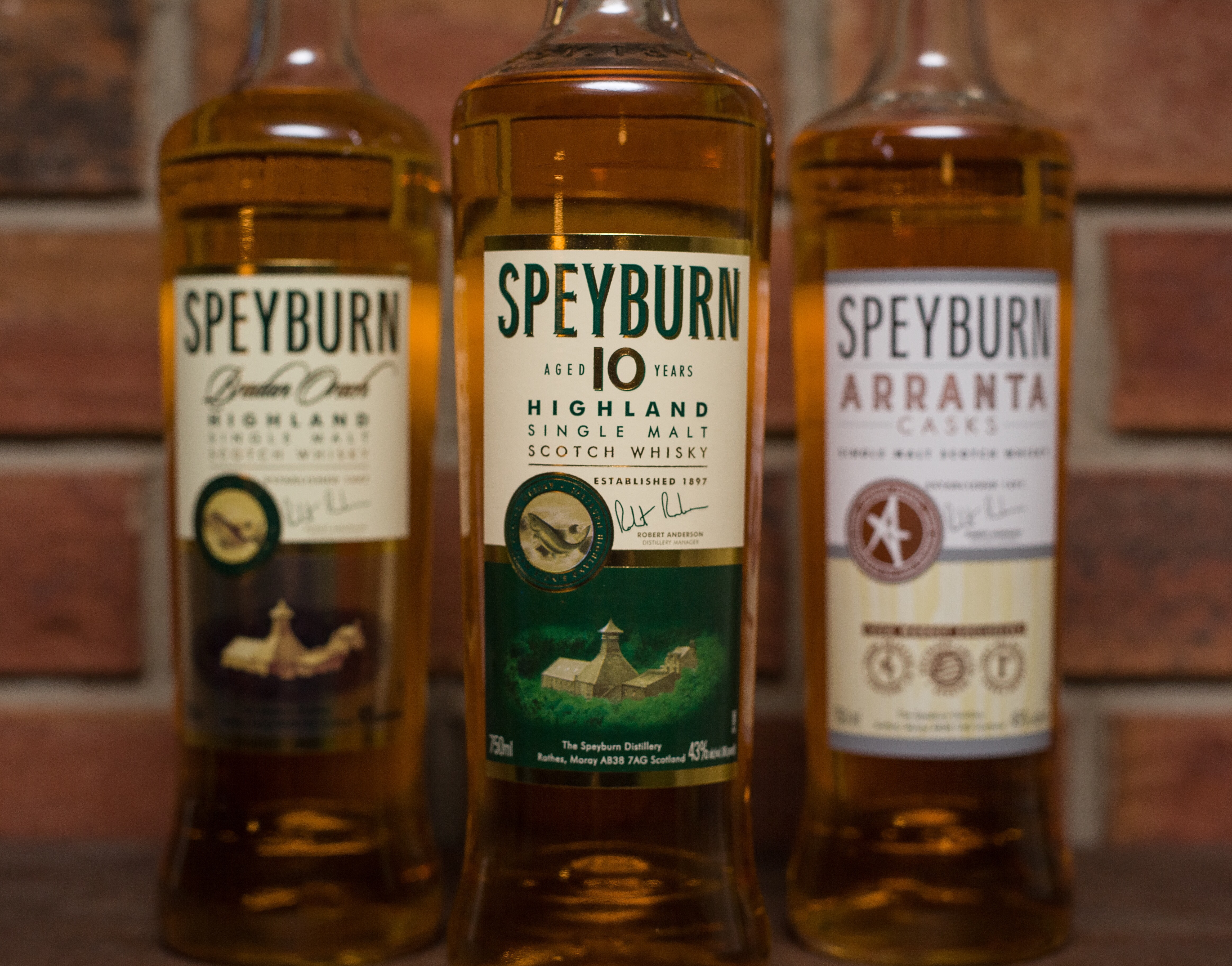
Speyburn isn’t that well known here in the United States, and those that do know it generally regard it as a great value pour.  The whisky coming from Speyburn is a light Highland style, so don’t look for huge peat or sherry notes here.  Their standard whisky portfolio consists of a 10-year-old whisky and two NAS whiskies, Bradan Orach and Arranta Casks.  I’ve seen the 10-year-old on the shelves of stores that have a decent whisky selection, so it’s readily available. It is a blend of American Oak ex-bourbon and ex-sherry casks.  Bradan Orach, Gaelic for “Golden Salmon”, is Speyburn’s entry level malt.  It is matured in ex-bourbon casks.  The U.S. exclusive Arranta Casks matures in first fill ex-bourbon casks.  

Speyburn 10-year-old is one of the best selling single malts in the world.  At some point it was a top ten selling malt, which may still be the case.  It’s bottled slightly above minimum at 43% abv.  My very first nosing reminded me of a less sweet Glenmorangie 10-year-old.  Both whiskies are delicate in style.  Speyburn 10yo features lightly-sweetened malt, slighty creamy caramel and a floral note.  There is also hints of sweet nectarine and spice.   On the palate, honeyed malt is complimented by hints of candied orange peel, stewed pear, pie crust, and vanilla.  The finish is a touch on the dry, slightly oaky side, and doesn’t stick around long.  Very much a light, clean whisky, and at about $25 a bottle, it’s a great value to boot!  8/10

Exclusive to the U.S. market is Speyburn Arranta Casks.  Like I mentioned before, this whisky has matured in first fill ex-bourbon barrels.  It carries no age statement, but features an even higher abv than the 10yo at 46%.  It’s priced about $40 a bottle. Those first fill ex-bourbon casks really mold the character of this release.  The nose is full of classic bourbon notes of toffee, vanilla and charred oak.  Some honeyed malt also shows through, but the richness is cut with grapefruit.  Otherwise, it’s less fruity than the 10yo.  Arranta Casks keeps a crisp flavor profile, probably due to it’s probable young age.  However, it wears its “no age statement” proudly.  A foundation of vanilla, caramel and sweet & buttery malt is supplemented by short waves of lightly-brewed green tea, orange peel, and oak spice.  That spice carries through to the medium-long, slightly dry finish.  I like this as much as I like the 10yo, albeit for different reasons.  It’s a touch drier, less fruity, and the higher proof will stand up to cocktails.  8/10

The entry level malt in Speyburn’s portfolio is the $20 Bradan Orach, another NAS whisky.  If Arranta Casks utilizes only first fill bourbon casks, my guess is there is mostly second and third fill casks here.  Brandan Orach is bottled at 40% abv and is the cheapest of the bunch.  Compared to the other two entries, this one is a bit of a disappointment.  The nose reveals a very young whisky, with sharp “green” malt, rubbing alcohol, light caramel and ripe apple.  On the palate, spiced apple, honey, and a tart citrus note slightly help mask the young malt.  The medium finish is a little sweet and mostly clean.  Rather okay-ish and without character.  With the 10 year old being such a nice whisky at a mere $5 upgrade, I see no reason to reach for Bradan Orach.  5/10

Thanks to Speyburn for the generous samples!  As always, all thoughts and opinions are my own.

A Trio of Loch Lomond Whiskies


This past September, the Loch Lomond Group brought a large part of its whisky portfolio to the United States market.  Today, we’re looking at two Loch Lomond blended whiskies alongside a single grain bottling.  

The Loch Lomond Group currently owns two distilleries: Loch Lomond in the Highlands and Glen Scotia in Campbeltown.  Something interesting about the Loch Lomond is it’s setup of stills.  It has a pair of standard pot stills.  Then, it has three pairs of pot stills with rectifiying heads as well as a continuous still.  The distillery only uses that column still to distill malted barley, which is what Loch Lomond Single Grain is made of.  It’s not a single malt, because single malts can only be distilled in pot stills.

Let’s talk about the three whiskies this post is featuring.  We’ll start with the cheapest – Loch Lomond Reserve.  At $19, Loch Lomond Reserve is a standard blend of malt and grain whiskies, married in re-charred oak casks.  It’s bottled at 40%, and tastes like a standard blend.  The nose has hints of light toffee, some floral and grain notes, and a touch of vanilla.  The entry is soft, and follows the nose closely: some grain, caramel, heather and vanilla.  The finish is short and soft, leaving behind a semi-sweet toasted grain note.  There’s not much going on with this one.  It’s not a bad blend.  Rather, it’s an easy-going blended whisky that’s probably meant for people wanting to get into whisky for cheap. 6/10

Up next is Loch Lomond Signature, which is priced $2 higher than Loch Lomond Reserve for $21.  If you’re looking for a decent blended whisky to start your whisky journey, I’d bypass the Reserve completely and reach for Signature as it tastes a bit more expensive than it actually is.  This blend is married in a 100 cask solera system, combining recharged Oloroso Sherry casks and American oak casks.  The still-soft nose is fruiter thanks to those sherry casks, featuring stewed fruit, raisins, some vanilla cream and buttered toast.  Loch Lomond Signature is also bottled at 40% abv.  The palate is still soft, but not as subtle as the cheaper Reserve.  Vanilla cream, berries, raisins, and light brown sugar make up the majority of flavors.  There is also a touch of young grain and spice.  The short finish features a touch of spice and stewed fruit.  7/10

Lastly is Loch Lomond Single Grain, bottled at 46% and priced at $29.  I appreciate the higher abv.  Like I mentioned before, this single grain release is made with 100% malted barley distilled in a column still instead of a pot still.  That is the only thing keeping this from being called a single malt.  On the nose, I get fresh cereal grains, ground cinnamon, and a touch of vanilla.  Taste-wise, there’s pineapple upside-down cake, vanilla, granny smith apples, lemon zest, and a bit of vanilla ice cream.  The finish features some spice along with orchard fruits and vanilla cream. 7/10

These releases are pretty standard.  I’d skip Loch Lomond Reserve and stick to Loch Lomond’s Signature and Single Grain releases.  Both are a lot more interesting in their own way, and are very affordable.
Thanks to Loch Lomond for the samples.  As always, all thoughts and opinions are my own.

A Chat with Chef Tory McPhail

Tory McPhail, Executive Chef of Commander’s Palace

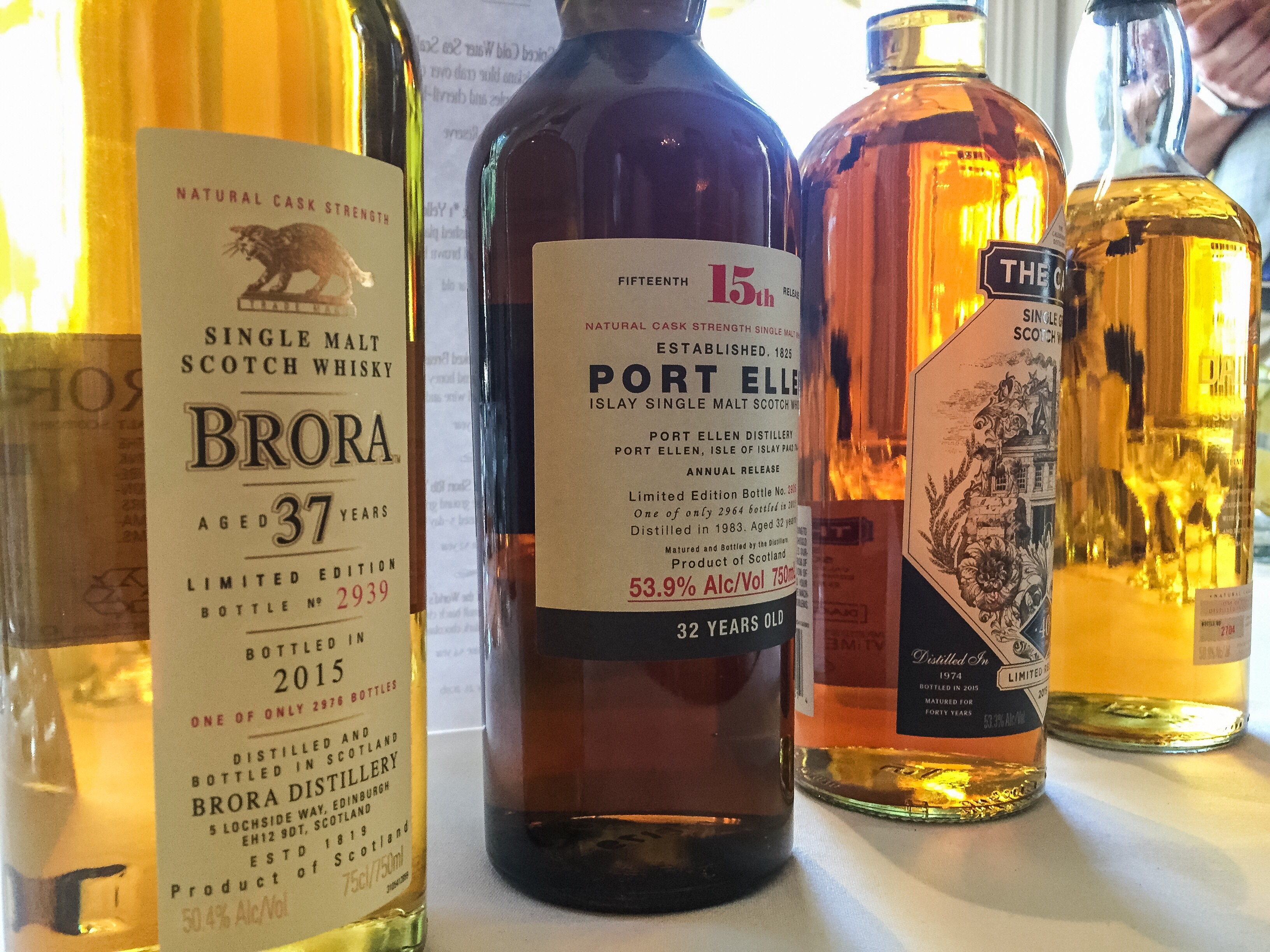
One of the events that will forever be etched in my memories is Diageo’s Spirited Dinner I attended at Commander’s Palace.  Each year during Tales of the Cocktail, one night is reserved for spirits companies to have a dinner and spirit (or cocktail) pairing at a New Orleans restaurant.  Several of these happen all across New Orleans.  When the Tales schedule went up, there were a few Spirited Dinners I had my eye on.  Some of these are invite-only, and some require a ticket purchase to attend.  The one at the top of my list was put on by Diageo.  They collaborated with Commander’s Palace Executive Chef Tory McPhail to come up with a dinner that paired with some of their 2015 Special Release Scotch Whiskies.

Some of the night's whisky selections.

Some of the night’s whisky selections.

I recently sat down with Chef McPhail to talk about the dinner in a little more depth.  Here are some highlights from our chat.

“For us, cocktails here in New Orleans are such a huge part of our culture.  At Commander’s, it’s a big deal as well,” said McPhail.  Food and wine pairings are common for Commander’s Palace, but this is their first whisky pairing.  “To have an opportunity to do this with some top shelf, really rare Scotches is a thrill.”

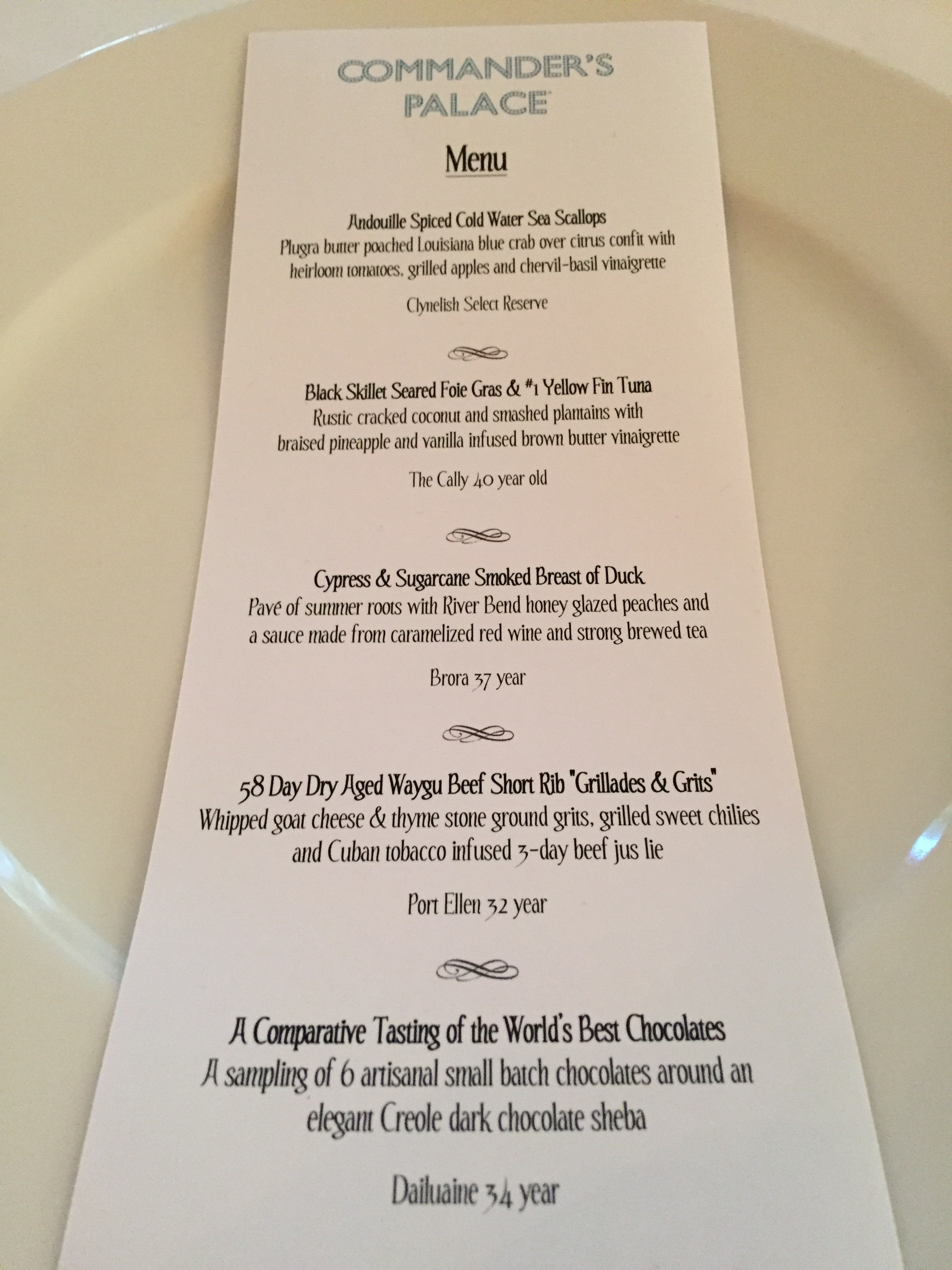
The evening's menu.

The evening’s menu.

McPhail told me he is normally a rum guy, but he enjoys all spirits.  So when Diageo initially contacted him about a whisky dinner, he jumped at the chance.  “They sent me 9 or 10 amazing whiskies (the 2015 Special Releases).  Tasting some of the flavors, be it chocolate or leather or brine, or what have you, it was pretty neat to create a menu based on what I tasted at the bottom of the glass.”

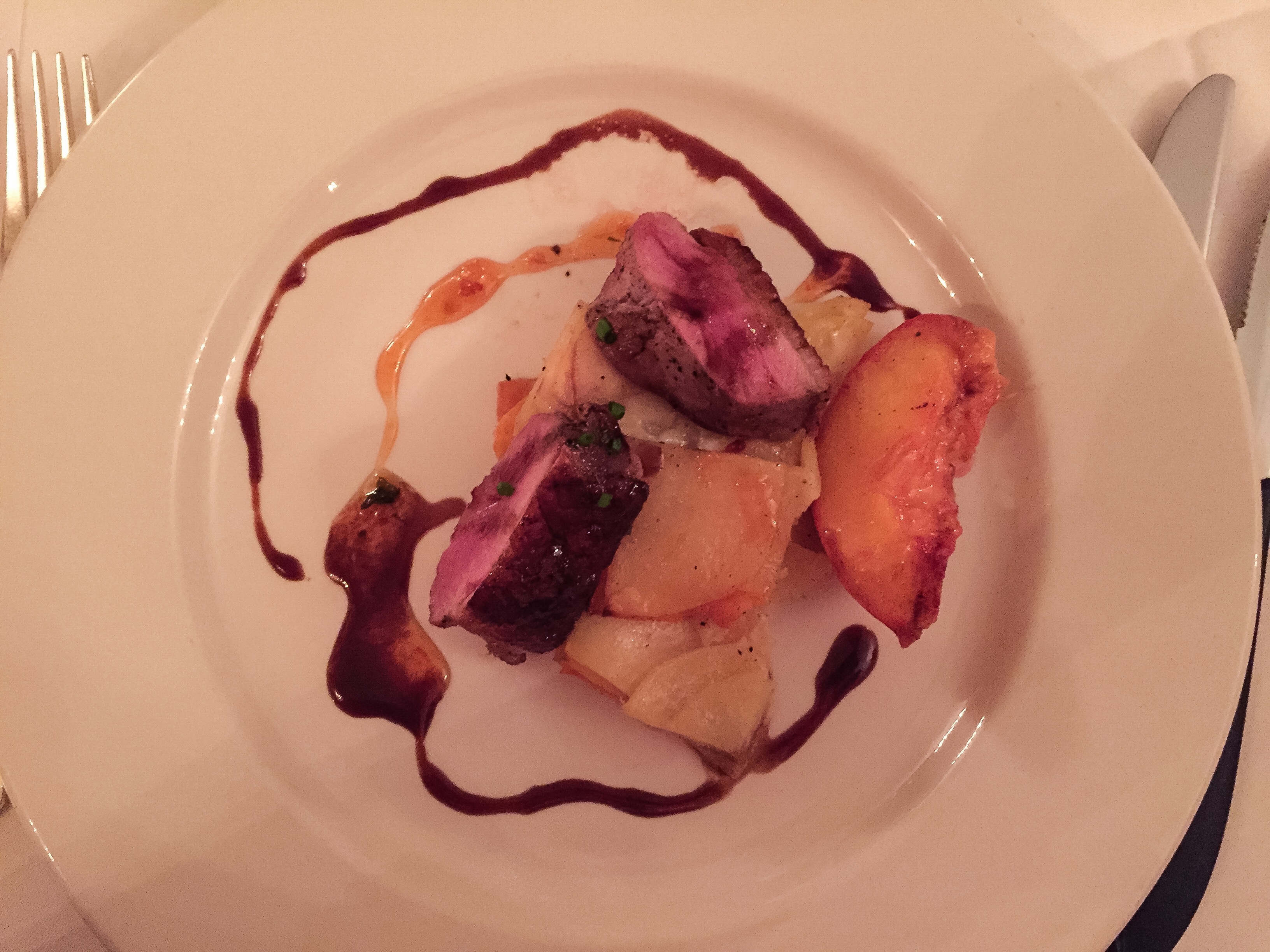
We talked about the third course, a Cypress & Sugarcane Smoked Breast of Duck paired with Brora 37 year. “I found the Brora 37 very unique.” McPhail recalled.  He wanted to pair those flavors with something special.  He said of the meal, “We brined the duck breast in molasses, brown sugar, red chili flakes and salt, then smoked them in cypress that we had upstairs. A buddy of mine is a woodworker, and thinks the cypress was milled in the late 1800s.”

A twinkle hit McPhail’s eyes when the conversation turned to history.  He gleefully continued, “Commander’s Palace was built in 1893 and that time NOLA was expanding very rapidly.  They cut down the cypress forest in what is present-day Mid City, around Bayou St. John. A lot of that wood went towards building houses in the late 1800s. We estimate a lot of those trees to be around 400 years old when they were cut down.  My buddy took that wood out of attics in Mid City after Hurricane Katrina. That wood’s been sitting in my buddy’s shop for 11 years drying. He saved me all the cypress from that time period specifically for Commander’s Palace, and that’s what we used to smoke the duck.”

Cypress & Sugarcane Smoked Breast of Duck, paired with Brora 37 year.

Cypress & Sugarcane Smoked Breast of Duck, paired with Brora 37 year.

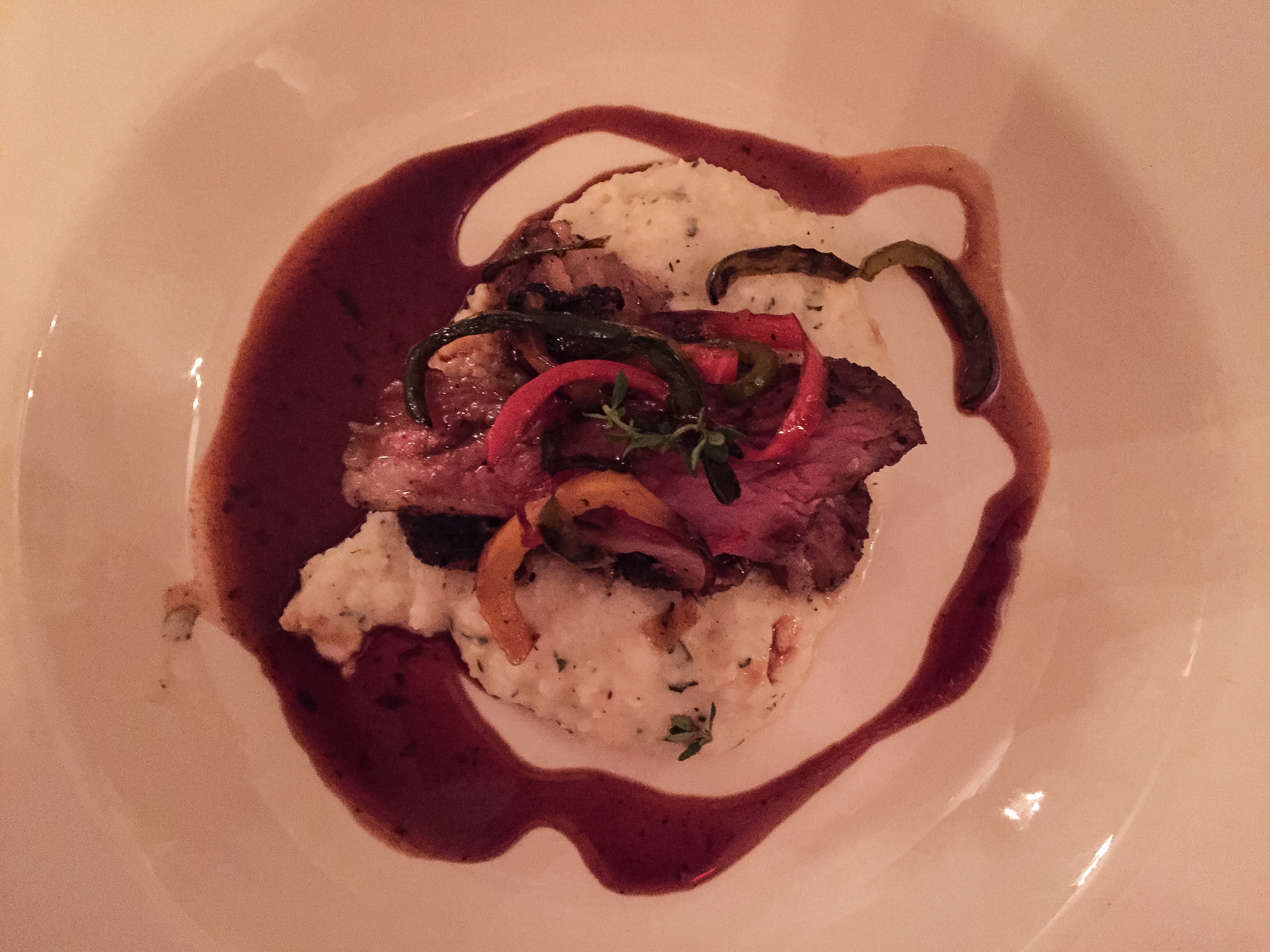
Then I asked about the beef short ribs, and its Cuban tobacco infused sauce.  “I knew I had the dinner coming up, and I had the unique opportunity to travel to Cuba,” he said.  “I’m a geek for food history, especially love Spanish food. We had the opportunity to see the largest settlement outside of Spain in the new world. There were already 30,000 people living in and around Havana by the time the pilgrims landed at Plymouth Rock. I brought back a bunch of Cuban cigars, and one was reserved for the sole purpose of being in the sauce for the short ribs for the Diageo dinner. So that was cool.”

58 Day Dry-Aged Waygu Beef Short Rib "Grilles & Grits", paired with Port Ellen 32 year

58 Day Dry-Aged Waygu Beef Short Rib “Grilles & Grits”, paired with Port Ellen 32 year

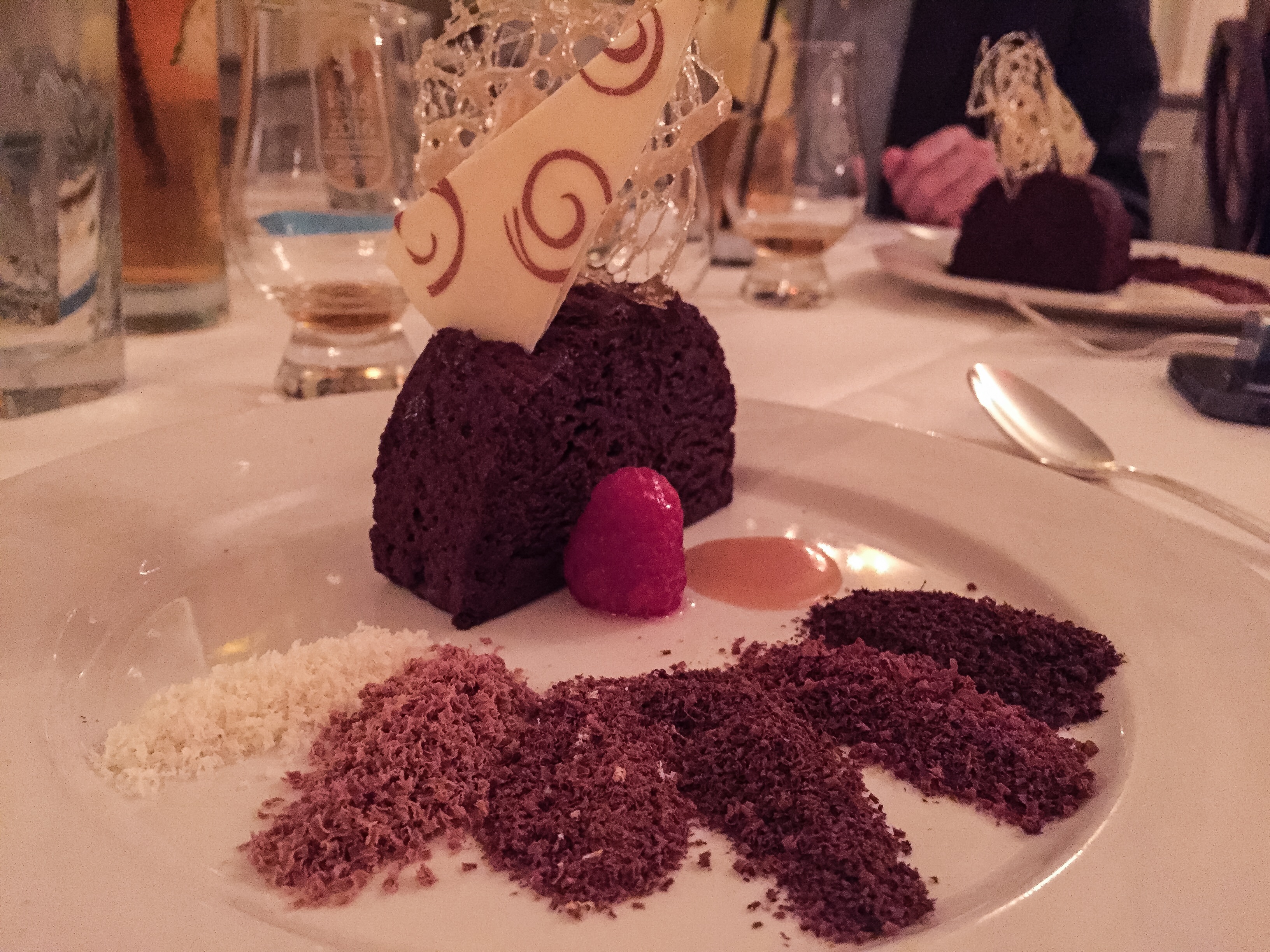
Finally, Chef McPhail talked about the chocolate dessert paired with Dailuaine 34 Year.  “I think whisky is so complex. There are so many nuances. It’s a really unique, artisanal product. Chocolate is the same.  So I chose six chocolates from around the world from some of the leading chocolate producers. We did a tasting of all of them, and I wrote down the nuances like I did originally for the whiskies. We laid them left-to-right on the flavor profile. As you taste the whole thing and taste the different scotches that were left, I wanted people to really get a flight in the progression of flavor.”

A Comparative Tasting of the World's Best Chocolates, paired with Dailuaine 34 year.

A Comparative Tasting of the World’s Best Chocolates, paired with Dailuaine 34 year.

When I asked about his overall feeling of the dinner, he smiled and said, “I walked away feeling very proud. We’ve never done a scotch dinner like this before. It’s Tales of the Cocktail! We have all these important friends coming in. For us to be able to do a menu like this plus have them bring very special whiskies is just really really cool.”

His favorite whisky of the night? “The Cally 40 year really stood out to me.”  Good answer Chef… Good answer.