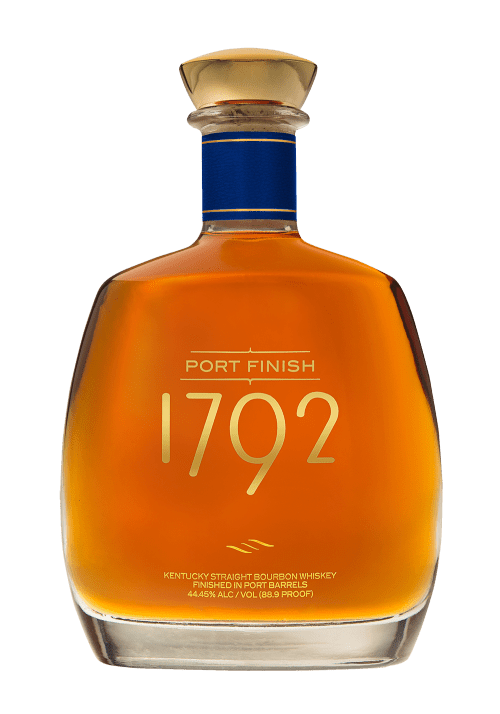
1792 Port Finished Bourbon Review

Photo courtesy Barton 1792 Distillery

Photo courtesy Barton 1792 Distillery

The newest expression from Barton 1792 Distillery is a port barrel finished bourbon.  Port-finished bourbon isn’t new, as the excellent Angel’s Envy is available on most shelves across the country, but this is the distillery’s first port finish.  1792 Port Finish Bourbon was aged for six years in new white oak barrels, then transferred to used port wine barrels for an additional two years and bottled at 88.9 proof.  It’s the distillery’s only batch, which makes it a limited release.  However, they are considering future batches.  Retail price is a suggested $39.99.

(more…)

Buffalo Trace Experimental Collection – 13 Year-Old Old Fashioned Sour Mash Bourbon Review

The latest Experimental Collection release from Buffalo Trace Distillery involves the sour mash process.  Just about all bourbon is made using sour mash.  Basically, once the mash is cooked, some setback (previously distilled mash) is quickly added to “sour” the mash before yeast is added for fermentation.  It helps control PH levels during fermentation, which affects the final flavor of the whiskey.  It also helps achieve consistency between batches.

What Buffalo Trace has done here is slightly different.  According to their press release, the mash was “cooked and cooled to standard; however, the similarities stop there. The mash was allowed “to sour” before yeast was added to start the fermentation process, a method long abandoned due to its more laborious process.”

These particular whiskies were distilled in 2002 and entered barrels at two different entry proofs – 105 and 125.  They were aged for 13 years on the seventh floor of Warehouse I.  Barrel entry proof also affects how the final bourbon turns out.

105 Entry Proof

The lighter nose of the two, the 105 Entry proof carries a large vanilla note.  I also get light caramel and cherries.  All the aromas here seem to be separated and easily picked out.  The official tasting notes mention vanilla and fruit for the palate.  That fruit to me is cherry.  Those two notes really dominate the palate.  There’s a hint of oak and little brown sugar.  The finish turns a bit dry.

125 Entry Proof

The nose here is a bit more traditional – caramel, vanilla, spice, and oak.  A caramelized cherry note is also present.  The aromas here seem more compact or concentrated compared to the 105 Entry Proof expression.  There is a bit more body here, maybe even oilier.  Oak spiciness shines here, along with fruit and light burnt sugar.  The finish isn’t as dry as in the 105, and comes across as sweet.

Buffalo Trace Experimental Collection releases are always interesting, and this Sour Mash experiment is no different.  The fun comes in comparing and contrasting the two sibling releases.  Both are superb whiskies, and I recommend picking both up to experience how different entry proofs will yield different whiskies.

8.5/10
(Note:  A review sample was provided by Buffalo Trace Distillery.)

And you thought Van Winkle whiskey was already hard to get…

Buffalo Trace Distillery sent out a press release this morning regarding the upcoming Van Winkle releases.  Seems evaporation is playing a huge factor in drastically less whiskey, making some them even harder to find.  You can read their press release below.

FRANKFORT, FRANKLIN COUNTY, KY (Oct. 14, 2015) – The long anticipated annual release of the Van Winkle bourbons is nearly here, but unfortunately some of the angels were extra greedy over the past two decades, leaving us less bourbon than in previous years.

“When bourbon ages over 15 years, much is lost to the angel’s share.  Many of the 53 gallon oak barrels often yield less than 20 gallons,” said Kris Comstock, bourbon marketing director. “Unfortunately this year we experienced poor yields on the older Van Winkle whiskeys.  Furthermore, we have strict quality standards here at Buffalo Trace and several of the older Van Winkle barrels did not meet those standards. This makes a drastic difference in volume, considering we have very few barrels as it is. The result is less 15 year-old Pappy Van Winkle than usual, and far less 20 year-old and 23 year-old. Frankly, about half as much as last year.”

            Known for their smoother and sweeter flavor, Van Winkle bourbons are aged years longer than most others and garner an impeccable reputation among connoisseurs.  Although the bourbons have become increasingly popular worldwide in recent years, very little is sold overseas, so that most of these coveted bottles are available in the United States.

The Van Winkle collection consists of several whiskeys. Suggested retail prices are as follows:

  • $49.99 – Old Rip Van Winkle Handmade Bourbon 10 Year Old 107 proof
  • $59.99 – Van Winkle Special Reserve Bourbon 12 Year Old
  • $99.99 – Van Winkle Family Reserve Rye Whiskey 13 Year Old
  • $79.99 – Pappy Van Winkle’s Family Reserve Bourbon 15 Year Old
  • $149.99 – Pappy Van Winkle’s Family Reserve Bourbon 20 Year Old
  • $249.99 – Pappy Van Winkle’s Family Reserve Bourbon 23 Year Old

“Although a lot of retailers charge more than our suggested pricing, we are not asking them to do so,” said Julian Van Winkle, president, Old Rip Van Winkle Distillery. “We have not raised prices and do not intend to do so drastically in the future. We are committed to our quality and our pricing.”

The Van Winkle line of whiskeys has won a multitude of awards through the years, including the 15-year-old being named “Excellent/highly recommended” in the 2014 Ultimate Spirits Challenge; the 20 year-old awarded “Extraordinary/ultimate recommendation” in the 2013 Ultimate Spirits Challenge; a double gold for the 20 year-old in the 2014 San Francisco World Spirits Competition; and the Chairman’s Trophy and “Extraordinary/Ultimate Recommendation” for the 20 year-old in the 2015 Ultimate Spirits Challenge.

The Van Winkle Whiskeys will be available starting in November, but please be mindful that supply is quite limited and bottles shall be hard to find in stores, bars and restaurants. They will be packed three bottles per case.