Booker’s Rye Whiskey Review

Readers of this blog know I’m a huge fan of Booker’s bourbon.  I think it’s generally the best whiskey Jim Beam produces.  Booker’s is a barrel proof bourbon usually aged between six and eight years.  The 25th Anniversary Edition from a couple of years ago was aged 10 years, and it was phenomenal.  My curiosity peaked when rumors of a Booker’s rye whiskey spread around social media earlier this year.  The time’s come to turn rumors into fact.
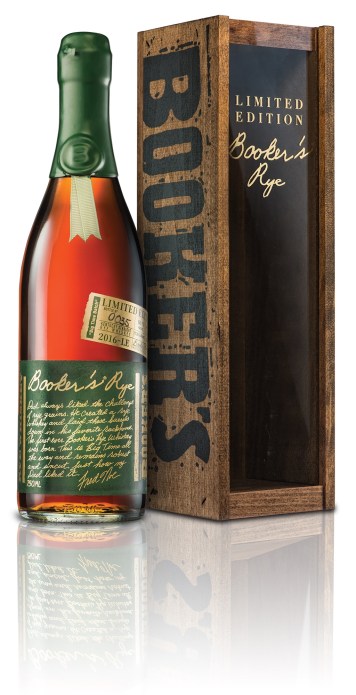
Photo courtesy of Booker's Bourbon

Photo courtesy of Booker’s Bourbon

Here we have Booker’s rye whiskey.  It’s a one-time release, and not your run-of-the-mill Jim Beam rye whiskey.  Apparently Booker Noe liked experimenting at the company’s Boston, KY plant (now known as the Booker Noe Plant).  He managed to distill rye whiskey from a mashbill containing between 70-80% rye grain, much more than what’s found in standard Beam ryes.  This is some of the last whiskey Booker Noe distilled before his death, and there’s not a lot of it to go around.  Press materials say this release is about half the size of Booker’s 25th Anniversary.  My best estimate is puts the number somewhere between 5,000 and 6,000 bottles.  Take all of this in, and it might help explain the $300 price tag this whiskey commands.

Booker’s Rye is aged 13 years, 1 month and 12 days, making this the oldest Booker’s release to date.  It’s also one of the strongest.  This whiskey is bottled at a whopping 136.2 proof, or as old timers would say, “this’ll put some hair on your chest.”

So how is it?

After this whiskey is done scorching your nose hairs, the smells are quite lovely.  Toasted rye and brown sugar lead off the nose, closely followed by anise, vanilla and a generous amount of oak.  This rye whiskey is viscous.  The legs on the glass go on for days.  A burst of concentrated dark caramel, brown sugar and vanilla attack your palate.  Sharp rye notes quickly develop.  It’s evident there’s more rye grain in the mashbill.  Warm biscuits show up towards the back palate.  The long, warm finish carries sweet rye grain, oak, and fresh mint notes.  After a while, the finish becomes a little dry, making you reach for another sip.

Booker’s Rye is going to go down as one of the best rye whiskey releases in years.  It’s that good.  I may have just added fuel to the bourbon black market fire by typing that.  Bourbon flippers will be out in droves trying to find this whiskey, which greatly slim down the chances of finding a bottle.  However, if you happen to be so lucky as to find one, open it up and savor it.  That’s the only reason whiskey exists.

9.5/10
(Note: A review sample was provided by the company behind this whiskey free of charge.  The opinions written are my own.)

Knob Creek 2001 Bourbon Review

Knob Creek 2001

The standard 9-year-old, 100 proof Knob Creek is a solid pour.  Then came its higher proof, single barrel brother.  That expression came in at 120 proof and proved to be much more than just “a little stronger”.  It’s packed with so much flavor.

So, when Jim Beam announced a limited edition, 14-year-old version of Knob Creek I couldn’t contain my excitement.  About 36,000 bottles (roughly 12,000 bottles per batch) of Knob Creek 2001 are being released, which isn’t a lot by any stretch of the imagination.  You’ll find three batches of Knob Creek 2001, each with a slightly different flavor profile.  Batch 1 favors the sweeter caramel and vanilla notes, while Batch 2 leans towards the oakier side of things.  In the middle of the two batches lies Batch 3.

Knob Creek 2001 has no inherent age statement on the label, but it is a 14-year-old bourbon distilled in 2001, hence the name.  Jim Beam Master Distiller Fred Noe said this whiskey is just shy of being 15 years old.  This limited release carries an SRP of $130.

In an attempt to do something a little different, I’ve posted my first impressions of Knob Creek 2001 on Youtube.  You can watch that video below or jump past that for my full tasting notes.

For the most part, my first impressions were echoed in this separate tasting.  The nose has big notes of slightly burnt caramel, concentrated vanilla bean, honey roasted peanuts with hints of old leather jacket.  Old dusty oak is present the entire time but never overpowers.  The entry starts with an initial burst of sweetness provided by the caramel and vanilla combination.  A wave of spicy cinnamon sticks and cloves takes over the mid-palate alongside some Jim Beam nuttiness.  The smallest touch of burnt orange peel pops up afterwards.  That old, tannic oak found in the nose ramps up throughout the entire tasting experience, peaking at the dry finish.

Knob Creek 2001 feels richer and more refined than the standard offering, which seems a tad anemic next to this.  This is Batch 1, which is supposed to be the sweetest of the three batches.  As I said in the video, this batch is about as oak-heavy as I’d want Knob Creek to be.  Any more oak will throw the whiskey out of balance.  If I’m buying, I’d reach for Batch 1.  While not the best value for the price (Knob Creek Single Barrel carries that honor), Knob Creek 2001 is quite an enjoyable bourbon and comes with a recommendation.

8.5/10
(Note: A review sample was provided by the company behind this whisky free of charge.  The opinions written are my own.)

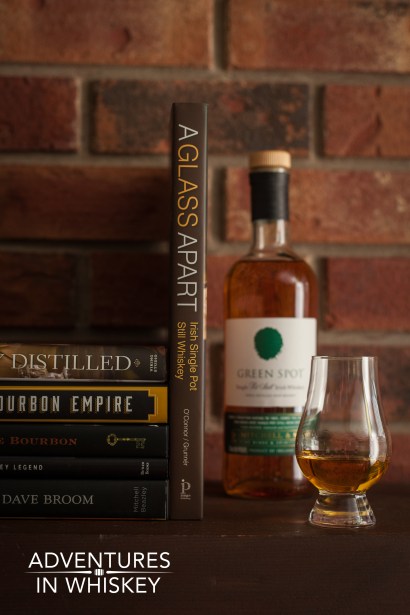
“A Glass Apart” – Book Review

A Glass Apart 2

With “A Glass Apart,” author Fionnán O’Connor hasn’t just given us a primer on Irish whiskey.  He provides a master class on the subject, and does so with the gravitas of a university professor and the tone of an everyday drinking man.

The book is even structured like a college textbook.  First, in the section entitled “Appreciation,” O’Connor talks about how to nose and taste whiskey without ever being a whiskey snob about it. O’Connor says, “If it’s a swelteringly hot day and you feel like having your Redbreast on the rocks, you’re not going to bring about the apocalypse.”  He tackles the flavors and aromas found in whiskey, and how those notes find themselves there.

A Glass Apart 1Then O’Connor explains whiskey production in a way that will teach whiskey newcomers a thing or two, but will also keep whiskey enthusiasts interested.  Grains, yeast, pot still shapes, types of barrels and other distillation processes are covered here.  Sometimes, he can get a bit geeky, and that’s okay by me.

O’Connor then gets into the big pot still whiskies, as well as the Cooley and Midleton Distilleries.  Accompanied by breathtakingly beautiful photos by Ove Grunnér, this section features flavor notes and histories for the big classic Irish post still whiskies like Redbreast expressions and Green Spot.

Speaking of history, a look at Irish whiskey’s past is given its proper due.  O’Connor recounts the glorious heights of the Irish whiskey industry, it’s unfortunate lowly period and it’s recent revival.  The book ends on a high note with a look at the companies and distilleries born in this new world-wide interest in Irish whiskey.

“A Glass Apart” belongs in the library of any serious whiskey enthusiast.  You think you know all about Irish whiskey until you read this book.  Then you realize just how much of an Irish whiskey novice you really are.

By the way, Mark Gillespie interviewed O’Connor on a recent episode of WhiskyCast.  It’s definitely worth a listen.

(Thanks to Images Publishing for the review copy.  Purchase your copy here.)