Reviews

A Word With Freddie Noe and a Little Book Preview

Image courtesy of Beam Suntory.


For the most part, I’ve quite enjoyed the whiskies that came from the hands of the late Booker Noe and his son Fred Noe – the current Jim Beam Master Distiller.  So it is with great anticipation that I get to preview THE debut whiskey from the eighth generation Beam, Freddie Noe.

Little Book, both the name of the whiskey and Freddie’s nickname, is scheduled to hit shelves this October.  This first batch, “The Easy,” is a blend of 13-year-old corn whiskey, 5-year-old rye whiskey, 5-year-old malt whiskey, and 4-year-old bourbon.  The ages of the component whiskies come courtesy of an informative article from writer Chuck Cowdery.  I’m being told by the company that the component malt and rye whiskies, once batched and bottled in the fall, will be “about 6 years-old each.”

So no, it’s not a bourbon.

Think of it as deconstructed bourbon.  The major grains of the component whiskies (corn, rye, and malted barley) are ones found in the traditional bourbon mash bill.  Cowdery also states in the aforementioned article that though Little Book is a blended whiskey, it contains no grain neutral spirit or flavoring.

Noe’s plan is to release a different blend each year.  He gets to experiment and has no shortage of barrels to play with.  In the tradition of his late grandfather’s namesake Booker’s, Little Book is uncut and bottled at barrel strength.  This sample I have is 120.48 proof.  As the whiskies are still in barrels and not yet batched together, the proof may slightly change.

Recently, Freddie Noe was kind enough to answer a few questions I threw his way.

BC: Freddie, let’s start with the name ‘Little Book.’ Tell us the story.

FN:  Little Book was my childhood nickname given to me by my family. It’s a nod to my granddaddy Booker Noe because people always thought we were just alike. I figured it was the perfect name to give my first release and pay tribute to my family.

BC:  How has your grandfather and father influenced your first whiskey release?

FN:  My Dad and my granddaddy are two of my biggest inspirations. I’ve always admired them for their character, and of course, their leadership in the bourbon industry. When I started working down at the distillery, I realized that my granddaddy and I had even more in common than I originally thought. Granddaddy was known for his spirit of experimentation, and when I started tinkering with whiskey myself, it awakened a real passion. For me, I love blending and the limitless taste profiles that can be created, and I knew that would be the foundation for my first release.

When I set down the road to bring Little Book to life, I tried to take into account all the lessons I’ve learned from my family over the years and during my time working with my dad at the distillery. Dad was one of the few who tasted Little Book before it was finished, and it’s being bottled uncut and unfiltered which I know is how granddaddy liked it too. Releasing Little Book is a big honor and responsibility, and I hope I’ve made the family proud.

BC:  This is the first high profile blended whiskey released by a major producer in a long time. Why blends of different types of whiskies instead of just a bourbon or rye release?

FN:  I’ve had just about every job at the distillery, but it was when I was working in our Global Innovation Center that I realized that I have a curious palate and a real fascination with blending. It’s like an open canvas. When you find just the right mix of liquids and blend them in the right amounts, you can create something that no one has tasted before.

When I was creating the liquid for Little Book “The Easy,” I wanted to pay tribute to what us Beams are known for – bourbon, and the core grains that make up a traditional bourbon mashbill. I blended corn, rye and malt whiskies together with Kentucky straight bourbon in varying proportions until I got the blend just right. The liquid streams in Little Book “The Easy” have been blended to create a taste profile that’s unique and one-of-a-kind.

BC:  Did you have an idea in mind of what you wanted when you set out to start this project, or did it evolve in the process?

FN:  I’ve been thinking about this product for a while now – it’s actually been years in the making, so when I got approval to create it, I was ready to get to work. It was a labor of love. I actually decided on the recipe for this blend on the second try, but it took me making more than 25 blends over the course of the last year until I decided the final liquid was just right.

Of course, Little Book will continue to evolve with a new blend being released each year. I’m excited to keep exploring all the possibilities with blending spirits and share some really unique liquids with whiskey fans in the coming years.

BC:  What do you think your grandfather would say after tasting this whiskey if he were still with us?

FN:  Well that’s the thing with my granddaddy – he’d tell you exactly what he thought, whether he liked it or not! But I like to think he’d be really proud and tell me “you done good!” To him, whiskey was meant to be drank however you liked it best, and in making Little Book uncut and unfiltered, you can do just that – you can drink it neat, with ice or even a little water. I like to think he’d add a couple drops of water to Little Book “The Easy” and enjoy it out on his porch swing.


As for the whiskey itself, the corn whiskey dominates.  Rich buttered kettle corn is the first aroma out of the glass, with a sprinkling of baking spices (most notably cinnamon stick) and a splash of maple syrup & butterscotch following closely.  The nose is a tad closed off, something remedied with a splash of water.  The whiskey is chewy (like great batches of Booker’s) with initial hints of butterscotch hard candy and sweet buttered cornbread, along with cinnamon, cloves, and some rye grain and nuttiness.  A bit of oak tannin appears on the backend into a long finish, with a hint of charred caramel corn.

It’s an interesting flavor profile, both reminiscent of classic bourbon and a complex corn whiskey.  I like what’s going on in the glass.  Little Book stands out as something a little different than a standard Beam bourbon.  Kudos to Freddie Noe for putting together a solid first release.  Fred, Freddie’s dad, should be proud.  8/10

Note: Updated on 8/11/17 to clarify the age of the component whiskies and proof of the final batch.

Partnering with Drizly.com and What I’ve Been Sipping Lately

A few weeks ago Drizly.com approached me about joining their Top Shelf Bloggers program.  Drizly is one of the more successful online spirits delivery stores out there, so I’m honored to have been asked.  This blog is all about spreading the whiskey word, so this new partnership might prove to be a great platform for that. 

They asked me to kick off my new relationship with Drizzly with a post about my favorite whiskey.  After all, I am a whiskey blogger, so I should have a favorite whiskey.  It’s a question I get asked very often by whiskey newbies or those looking to try something new.  Let’s clear the air – I don’t have a favorite whiskey.  Not one. “But Bobby, you’re a whiskey blogger.  Surely you have a favorite?”

No, and don’t call me Shirley. 

The whiskey I imbibe depends on my mood.  Sometimes I want a rich, sherried single malt or a smoky, peated one.  Other times I’ll reach for a good ole’ American bourbon or rye.  Again, it depends on what mood I’m in.

If I started listing every whiskey I loved, we’d be here a while.  Instead, you’ll find a list of whiskies (and cognacs) I’ve been reaching for at home recently.  I’ve avoided adding limited release whiskies or really expensive ones, so all of these should be easy to find.  In no particular order:

Let’s start with some bourbon. I like Elijah Craig Small Batch bourbon.  This 8 to 12-year-old whiskey is full of classic “bourbony” notes we all love, such as caramel, vanilla, oak and spice. The cask strength Booker’s bourbon is an option for those looking for a more robust drinking experience.

Want something a little smokier?  Try Lagavulin 16-year-old.  It’s a beautifully balanced whisky with an elegant, balanced flavor.  If you want something with more of an edge, reach for Laphroaig 10-year-old.  The peat in the latter option is ramped up, providing a more in-your-face whisky.

Maybe smoky whisky isn’t your thing, and that’s perfectly fine.  It’s a “love it or hate it” kind of thing.  Glenmorangie 10-year-old is a lighter style whisky filled with honey and floral notes.  I like this one over ice.  Speaking of which, there is no right way to drink whiskey as long as you enjoy it. Neat, with a splash of water, or on the rocks, there is no wrong way.

If you are in the market for something completely different, try cognac.  Like whisk(e)y, cognac is a distilled, barrel-aged spirit.  Because cognac is distilled from wine, it is much frutier than whiskey.  I’ve been sipping a lot of Hennessy XO and Courvoisier XO as of late.  Hennessy is bolder in character, while Courvoisier tends to be a bit lighter and more floral.  Both are pricier than the previously mentioned whiskies, so that may be a deciding factor as to whether you’re able or willing to pick up a bottle.  You can go Hennessy VSOP if you’re on a budget.  Lastly, Copper & Kings in Louisville make a 100 poof American brandy that’s as bold and flavorful as any bourbon you’ve come across.  

You can purchase all of these spirits at Drizly.com and have them delivered straight to your door.

The Hennessy Experience

This year at Tales of the Cocktail, Hennessy showed up with a mission to impress and educate.  The cognac giant held “The Hennessy Experience,” walking attendees through the cognac making process as well as an unmatched cognac tasting.

While waiting for the event to start, attendees enjoyed refreshing Hennessy cocktails.  I asked for a Sazerac – remember, the classic cocktail was originally made with cognac, not rye whiskey.  This version was less spicy and much fruitier than the standard rye whiskey-based recipe.

Photo courtesy of Hennessy.

Hennessy Brand Ambassador Jordan Bushell kicked off the experience with a pour of wine made from ugni blanc, the grape varietal most associated with cognac.  The wine was bright and vibrant, and contained a mineral quality.  It had some light citrus notes as well.  Not bad, but not something I’d reach for.  Ugni Blanc might not make a nice wine, but it does wonderfully once distilled.

We were then handed an eau de vie distilled from 100% Fin Bois.  Fin Bois is one of several sub-regions, or crus, in the Cognac region.  The other crus include Grande Champagne, Petit Champagne, Borderies, Bon Bois, and Bois Ordinaire. Champagne in this case doesnt mean the wine making region.  Instead, it refers to the chalky soil of the region.  The eau de vie was slightly sweet and fruity, with a touch of minerality.


Bushell discussed the distillation process at length, as well as how Hennessy works closely with the many winemakers in the area. He then moved into barrel maturation.  By law, cognac producers can only use French oak casks.  Where bourbon producers here in America may only use a barrel once, cognac producers can reuse barrels as much as they want.  Hennessy’s oldest barrel dates back to 1830.

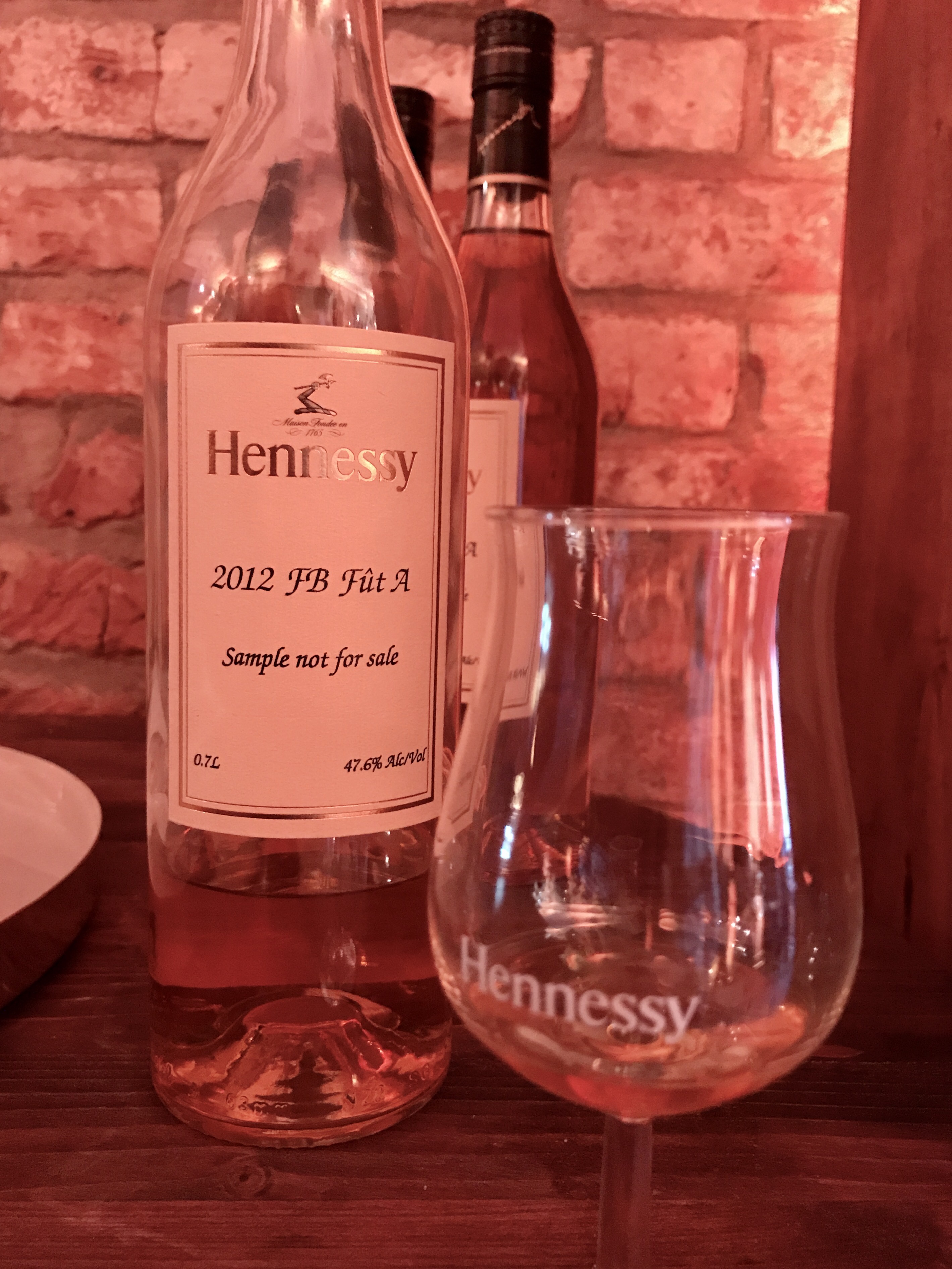
Maturation consists of many grades of casks and two different types of cellars.  A Category A cask has a strong toast, imbuing strong oak notes to the spirit.  A Category B is one that’s been used for a year, and will continue to age eaux de vie for two to four years.  A cask of this age still has a large amount of tannins.  Category C casks are used from five to nine years.  Bushell said less than 40% tannins are left in a barrel this old.  Once a cask reaches 9 to 20 years in age, it is considered Category D.  There is barely any tannin left to give to the aging eaux de vie.  The oldest barrels, Category E, are 20 – 35 years old.  These are used to “finish and polish,” according to Bushell.  At this point, these barrels are neutral and have little to nothing to add to the spirit. We were shown how these different casks affect the same eaux de vie by trying two different 4-year-old Fin Bois.  One was aged in Category A barrels and another in Category D barrels.  The former featured lots of orchard fruits, dried fruit and spice, while the latter was a bit more subdued and really showcased the grape character of the spirit.  

Hennessy National Brand Ambassador Jordan Bushell explains the maturation process.

What I found most interesting is Hennessy’s tasting committee.  The eight member committee, now led by new Master Blender Renaud Fillioux de Gironde, gathers every morning in a small white room to taste the previous day’s eaux de vie.  Nothing new here, right?  Wrong.  Here’s where it gets interesting.  Based on what they taste, the decide what kind of blend (VS, VSOP, XO, etc.) that unaged spirit is destined for as well as what barrel category the eaux de vie is going to spend its future in.  Insane.

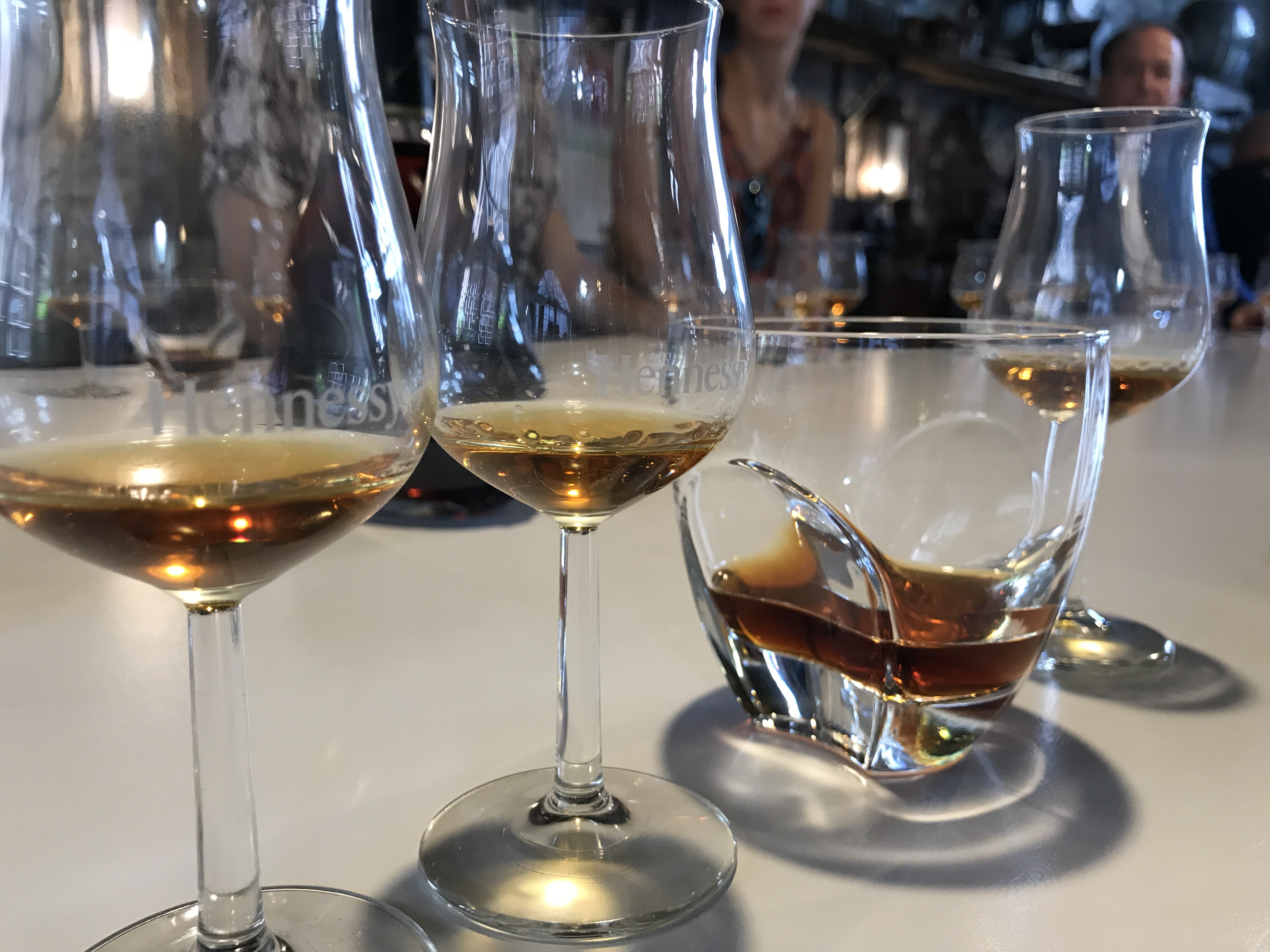
We then met with Oliver Paultes, Hennessy’s Director of Distillation and member of their tasting committee, who gave me some insight on the distillation process as well as a tasting of three different cognacs.

Hennessy Director of Distillation Olivier Paultes

I asked about the difference between distilling grains (whisky) and wine.  Paultes replied, “In Cognac, the wine is different every year, so we have to adapt our distillation to get the best concentration of wine. For example, sometimes you have more lees one year over another. ”

Our first pour was a 20-year-old Fin Bois at 49% abv.  This was bold in nature, compared to the 4-year-old Fin Bois I had moments before.  

Olivier Paultes led our group through a tasting of several rare cognacs.

Blending is an integral part of making cognac, but keeping consistency between those blends can be a challenge. Paultes and the rest of the tasting committee have found a way to make the process more manageable.

 “We select some eaux de vie with special character that is easier to reproduce because you have more consistency,” said Paultes.

The next cognac was a 30-year-old Grande Champange at 56% abv, which was lighter in style and very elegant in flavor.

I left some instructions on a barrel head.


One thing Hennessy does during the maturation process is proof down the cognac while in the barrel.  It’s a process that’s done slowly over the years.  Paultes explained, “Because you have fatty acids in new eaux de vie, if you reduce it too quickly you have a chemical reaction called saponification, which is basically soap.  You never reduce it more than 8% at a time.  If you have an eaux de vie at 70% that you want to use quickly – when I say quickly I mean over six to eight years – you reduce it from 70% to 62% abv maximum.  One or two years later you reduce it more, but never more than by 8%.  Anything more than 8% and you start to smell soap.”

The final cognac was a doozy – a 52-year-old Grande Champange from 1965 at 49% abv.  It was the essence of elegance, with more nuanced floral and fruit flavors than I can describe.  That’s one cognac that belongs on anybody’s bucket list.

Over the course of 90 minutes, I gained a new appreciation for the cognac-making process.  There’s a lot that goes into each pour of cognac.  It’s something to think about next time you savor a little eaux de vie.

Thanks to the team at Hennessy for having me at this event.