whisky review

Bruichladdich & Port Charlotte

Photo courtesy of Bruichladdich Distillery

Photo courtesy of Bruichladdich Distillery

The Bruichladdich Distillery has been around since the 1880s, and it has been producing whisky pretty much since then.  Originally founded by the Harvey brothers, it changed owners several times since.  It’s currently owned by Rémy Cointreau.

The distillery has three different lines, so to speak.  There’s Bruichladdich, Port Charlotte and Octomore series.  Bruichladdich features unpeated whiskies, including their standard Classic Laddie expression.  Port Charlotte, named after the Islay town, is a series of heavily peated whiskies.  The Octomore series are limited edition super-peated releases.  Bruichladdich utilizes tall long-necked stills for distillation, resulting in a light and floral spirit.

Bruichladdich carries the theme of authenticity throughout all their releases.  For starters, that  means their whiskies are non-chill filtered and color free.  Both of the standard whiskies below are bottled at 50% abv.

Bruichladdich The Classic Laddie
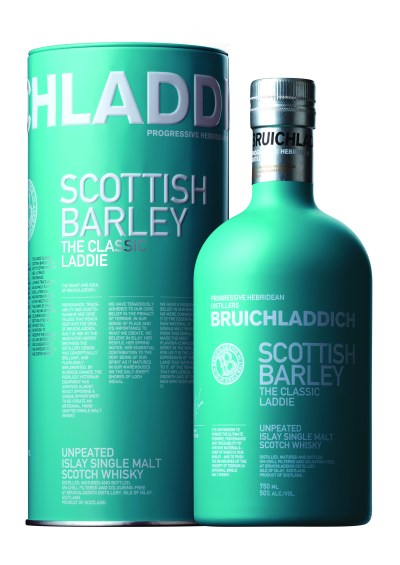
Photo courtesy of Bruichladdich.

Photo courtesy of Bruichladdich.

This unpeated offering is the distillery’s flagship bottling.  The whisky is made from 100% Scottish barley and aged entirely on Islay.  See, a lot of distilleries age a large percentage of their stock on the Scottish mainland.  The only other “standard” unpeated Islay whisky I know of is Bunnahabhain.  Their’s does retain a slight salty note reminiscent of maturation near the Atlantic.

How is it?  On the nose, there’s a rich honeyed malt.  A little alcohol vapor aside, The Classic Laddie offers a touch of citrus (think crisp lemon rind) and some vanilla.  Tasting this neat, the higher proof comes into play.  It’s not “smooth” and reminds me I’m drinking whisky.  There are big honey, light toffee and malt notes right off the bat, along with lemongrass and a floral note.  That honeyed malt note carries over into the long finish.

While not overly complex, The Classic Laddie offers a full-flavored whisky that retains a crispness and lightness.  I didn’t get any saltiness or maritime notes.  Instead, this expression lets the malt shine, and that’s not a bad thing.

8/10

Port Charlotte Scottish Barley
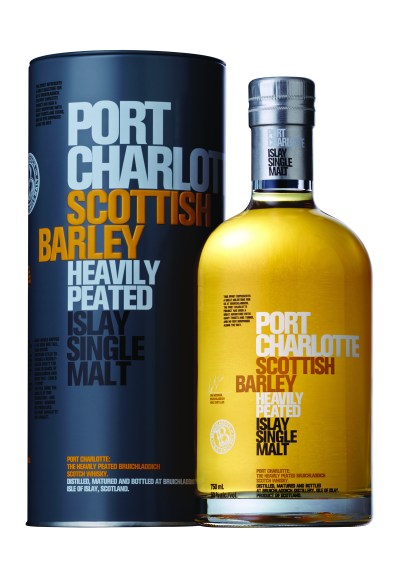
Photo courtesy of Bruichladdich.

Photo courtesy of Bruichladdich.

Onto the peated stuff.  Port Charlotte (PC) is distilled at the Bruichladdich distillery and matured a couple of miles away at old aging warehouses in Port Charlotte.  According to the bottle, PC carries peat levels of 40PPM, or 40 phenol parts per million.  A lot of other peated whiskies are usually at or below 25PPM.  This expression is another member of the company’s core lineup.

As soon as I uncorked the bottle, I knew I was in for a phenolic treat.  The nose is full of antiseptic spray, vanilla, honey and a slight earthy note.  It’s not as heavy a hit of peat as Laphroaig 10 year.  Here, the peat is a bit lighter but still full of character.  I hope I’m making sense here.  Taste-wise, there’s a nice combination of sweet and peat.  Toffee, bandages, citrus and floral notes dominate.  There’s a touch of smoke, but I wouldn’t refer to the whisky as “smoky.”  I get the peatiness first and foremost.  The smoke is just a minor role in a large cast of characters.  In the background, some tropical fruit can be found as well.  Some maltiness pops up heading into the long finish.  Soon after that peaty “bandaid” taste pops up.

It’s nice to encounter a peated whisky that retains a lightness.  Don’t get me wrong, I love whiskies like Laphroaig and Ardbeg, but they are heavy and smoky.  Port Charlotte is different.  It manages to keep the light and floral qualities of it’s non-peated Bruichladdich Classic Laddie.  Very well done.

8/10
(Note: Review samples were provided by Bruichladdich.)


Did Somebody Say Ardbeg? A Review of their 10-year and Uigeadail Expressions

Photo courtesy of Ardbeg Distillery.

Photo courtesy of Ardbeg Distillery.

I’ve never had the pleasure of drinking Ardbeg.  That is, until this tasting.  You see, until fairly recently, I wasn’t interested in Scotch.  My whiskey drinking was limited to bourbon and rye whiskey.  The former is a generally sweeter style of whiskey, and like most Americans, I have a sweet tooth.  Then as the fascination obsession with American whiskey grew, the once great selection of fantastic bourbon and rye on store shelves shriveled and simultaneously retail prices increased.  I found myself spending less time browsing the bourbon aisle and more time looking at Scotch.  After a while I began researching Scotch whisky and realized the abundance of outstanding bottles simply collecting dust on shelves.  I then made the decision to broaden my palate.  I began my Scotch journey with a few blended whiskies (Johnnie Walker, Chivas Regal, Famous Grouse) and standard “beginner” single malts (Glenlivet, Glenfiddich, etc.) and worked my way to much more complex offerings.  Eventually it came time to explore Islay whiskies.  Instead of starting with something unpeated or mildly peated like Bruichladdich or Bunnahabhain, I went straight for one of the biggest whiskies produced on the Islay – Laphroaig.  From the moment I opened the bottle and that lovely peaty aroma filled the room, I was hooked.  Many months (and whiskies) later, I decided to properly revisit Islay whiskies with this current series.  Which begs the question: if I love Laphroaig, how is it I’ve never tasted Ardbeg?  Let’s briefly talk about the distillery and get into the tasting.

Like the Laphroaig Distillery, the Ardbeg Distillery celebrated its 200th anniversary in 2015.    The two are similar in that both distilleries produce some of the peatiest whiskies on Islay.  Ardbeg almost has a cult following.  Fans of the brand REALLY love Ardbeg.  Ardbeg does not chill-filter their whisky, and most releases are bottled higher than the standard 40% abv.  While not outright stated and based on the color of their whiskies, Ardbeg doesn’t seem to add caramel coloring.

The distillery has been owned by Glenmorangie since 1997.  Two men are mainly responsible for what’s being bottled – Mickey Heads and Dr. Bill Lumsden.  Heads is an Islay native who is the current distillery manager.  He’s responsible for the everyday distillation.  When it comes to crafting new blends of Ardbeg, Dr. Lumsden, who also oversees Glenmorangie, is the key figure.  Both men pour their hearts into their work, and it’s evident in the whisky.

Ardbeg 10-Year-Old

Photo courtesy of Ardbeg Distillery.

Photo courtesy of Ardbeg Distillery.

Just like Laphroaig, Ardbeg’s base expression is a 10-year-old single malt.  This whisky is matured in ex-bourbon casks and bottled at 48% abv, giving the whisky some punch and allowing the flavors and aromas a better chance to shine.

The nose is strongly peaty, giving us some earthy and briny notes.  A light caramel sweetness gives this whisky some balance.  I do get a sense a barbecue on a beach here.  Interestingly, a small citrus note creeps up in the background.  Taste-wise, a peat punch straight out of the gate.  Instead of an upper-cut, it’s more of a strong right hook.  Brine, light toffee, and vanilla are the key players here, all over a bed of smoke.  With some airtime, the sweet notes become a tad more prominent.  The finish is long, sweet and smoky, eventually developing that small briny note.

A criticism of the current bottlings of Ardbeg among experienced whisky enthusiasts is that the whisky just isn’t as good as it once was.  As I haven’t tasted older bottlings, I can’t really agree or disagree.  What I will say is the current Ardbeg 10-year-old is a full-bodied masterclass of peated Islay whisky.  If this is the base expression, I can’t wait to explore other offerings from the distillery.  A bottle of Ardbeg 10-year-old should cost around $55.

8/10

Ardbeg Uigeadail

Photo courtesy of Ardbeg.

Photo courtesy of Ardbeg.

Another whisky in Ardbeg’s core lineup is Uigeadail (Oog-a-dal).  It’s named after Loch Uigeadail, which is the distillery’s peaty water source.  Uigeadail is a cask-strength (54.2% abv) expression that blends whiskies matured in ex-bourbon casks and ex-sherry casks.  There’s no age statement found here, but that’s not an issue.

The sherry cask-matured whiskies provide a nice richness to the nose.   In addition to the “peat reek” found in Ardbeg, dried fruits and stewed fruits are abound, specifically raisin and prunes.  After the initial alcohol sting of the entry, Ardbeg Uigeadail becomes a smoky and fruity beast.  I don’t get the earthy peat notes like I do in the 10-year-old because they’ve taken a backseat to the fruit notes.  Raisin, dry red wine, toffee and vanilla play well with the smoked meat notes.  There’s a subtle brininess buried here as well.  The long finish is a blend of smoke and tropical fruit (almost like a fruit punch).

I seem to be a sucker for sherried peated whiskies.  Bowmore 15-year and Laphroaig 32-year come to mind.  This is an exquisite whisky.  Although it doesn’t represent Ardbeg’s style as well as the 10-year expression, Uigeadail might be my favorite of the two.  Highly recommended.  A bottle of Uigeadail retails for about $79.

8.5/10
(Note: Review samples were provided by Ardbeg.)

Bunnahabhain 12-Year-Old Single Malt Scotch Review

Photo courtesy of Bunnahabain Distillery

Photo courtesy of Bunnahabhain Distillery

The Bunnahabhain distillery has graced Islay since 1881.  Located on the northeastern part of the Island, the whiskies coming out of here are known to have a much milder flavor profile when compared to other whiskies produced on Islay.  This is partially due to limestone-filtered spring water, which contains no peat.  The brand is currently owned by Burn Stewart Distillers, and is a major malt component of Black Bottle blended whisky.  An internet search revealed that Bunnahabhain didn’t release it’s first single malt until the 1970s.  Before that the whisky distilled here was strictly used for blending into Black Bottle.

Photo courtesy of Bunnahabhain Distillery.

Photo courtesy of Bunnahabhain Distillery.

The 12-year-old whisky is the distillery’s youngest age-stated expression.  It’s un-chillfiltered and natural color.  Bunnahabhain says the rich color is due to the use of some sherry casks.  Kudos for the higher-than-normal abv.  Here, it’s presented at 46.3%.

The nose is rich with salted toffee and dried fruits.  There’s no peat to be found here.  The entry is intensely flavored.  Strong notes of toffee, fruit, salt and vanilla all swirl around a background of soft, bittersweet oak.  This reminds me more of a Highland malt than an Islay malt.  The finish is long, warm and carries a sweet and slightly salty note.  A small splash of water opens this whisky up nicely, but don’t go overboard.  A drop or two will do.

Re-tasting Black Bottle blended whisky, I can easily pick out the influence Bunnahabhain adds.  By itself, it is a lovely and robust sweet and salty malt.  Bunnahabhain 12-year-old has instantly become one of my favorite whiskies.  Don’t be like me and hold off on tasting this delightful whisky.  I hope to find and taste their 18 & 25 year-old expressions soon.

8.5/10
(Note: Review samples were provided by Bunnahabhain.)