Single Malt

Glenmorangie “The Original” Single Malt Scotch Whisky Review

Dr. Bill Lumsden is obsessed with wood.  Lumsden is head of distilling and whisky creation for the Glenmorangie Company, which owns the Ardbeg and Glenmorangie distilleries.  If you examine the range of Glenmorangie expressions, you get an idea of Lumsden’s fascination with how different barrels affect his whisky.  The distillery pioneered the idea of finishing whisky, which is a brief secondary maturation in a different type of barrel than used during the primary maturation.

Glenmorangie owns a forest in Missouri.  Casks made from this good ole’ American oak are leased to some American distilleries.  Heaven Hill is rumored to be one.  These American distilleries age their bourbon, then turn over the used barrels to Glenmorangie.
Glenmorangie 10yr

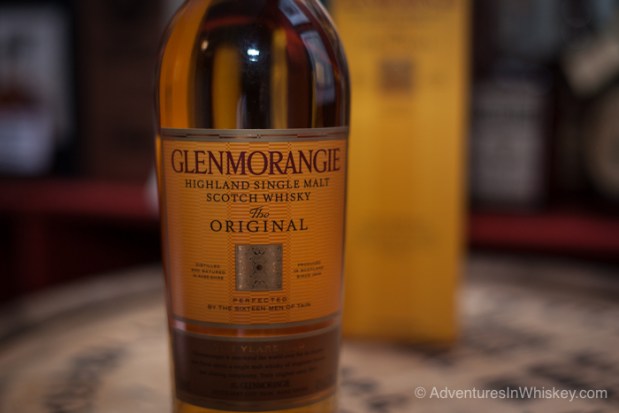
The youngest Glenmorangie whisky aged in these barrels is their 10-year-old expression: Glenmorangie The Original.  Most, if not all, of the rest of their expressions then go on to a brief secondary maturation in a variety of different casks, like the new Glenmorangie Milsean, which is finished in re-toasted ex-wine casks.

Glenmorangie The Original is the distillery’s simplest whisky expression.  Ten years in first and refill ex-bourbon casks.  That’s it.  But don’t let that simplicity fool you.  Glenmorangie’s stills, the tallest in Scotland, produce a light and floral spirit that, combined with meticulous wood management, lead to a sweet, complex whisky.  This expression is bottled at 43% abv.

Glenmorangie 10yr B

The nose is on the lighter side, but still maintains a richness about it with notes of light toffee, honeysuckle and vanilla.  Sweet malt provides a rich quality, while lemon rind adds some brightness.  Those last two aromas mentioned are the first flavors encountered on the entry.  The bourbon cask maturation adds a bit of sweet toffee and some vanilla bean, as well as a bit of well-integrated oak.  Then there’s light fruit and the not-quite-subtle floral character.  No flavor note outweighs another, giving us a beautifully balanced whisky.  The finish is full of honeyed malt.  It’s clean and doesn’t last too long.

This isn’t a “heavy” whisky.  Instead it’s a highly flavored, delicate whisky.  I can see why this is the best selling single malt whisky in Scotland.  Glenmorangie “The Original” is one to pull out for a friend who’s never tasted Scotch.  At the same time, it should please even experienced whisky drinkers.  Recommended!

8.5/10
(Note: A review sample was provided by Glenmorangie.)

The Macallan Edition No. 1 Single Malt Scotch Whisky Review

Photo courtesy of The Macallan.

Photo courtesy of The Macallan.

The Macallan Edition No. 1 is the start of a new series from the distillery, with a new expression scheduled to be released annually.  Each edition will be “co-created with different partners” while “showcasing The Macallan’s mastery of wood.”

Edition 1 features a blend of single malts matured in 8 different styles and sizes of European and American oak casks.  As is the new norm for Macallan releases, this new series does not feature age statements.  This first expression in the series is bottled at an above average 48% abv and retails for $99.

Those different casks lend to a very rich, sherried nose one attributes to a Macallan whisky.  Dried fruits, spice, and vanilla dominate alongside sweet, honeyed malt.  Some of that malt is young, which provides a vibrancy in the nose.  Taste-wise, there’s a large toffee note right off the bat.  Sherried dried fruit follows and combined, everything comes across as a sort of Christmas fruit cake. Some spice (clove, nutmeg) makes itself known in the mid-palate.  With all this and the 48% abv, you’d think this was a “heavy” whisky.  On the contrary, like on the nose, these heavier notes are balanced with citrus and young malt.  The long, warm finish is spicy and sweet, with the latter provided honey and sherried fruit.

At $100 a bottle, Macallan is priced right for what’s in the bottle.  Is this worth $35 more than the 12? I think so.  It’s got more character for me than their standard 12-year-old expression, but only a bit.  I like what Macallan is doing with their blending of different casks.  It’s richer and more sherried than the 12.  Good stuff.

8/10
(Note: A review sample was provided by Edrington Americas.)

Laphroaig Triple Wood & 18-Year-Old Single Malt Scotch Whisky Reviews

Photo courtesy of Laphroaig.

Photo courtesy of Laphroaig.

Readers of this blog know I’m a huge fan of Laphroaig whiskies.  I’ve enjoyed every expression of Laphroaig, except for their Select release.  I found that one to be a bit underwhelming.  So, when I decided to post a series of Islay whisky reviews, including Laphroaig was a no-brainer.  To this point, I’ve reviewed every core expression of Laphroaig except for the 18-year and the Triple Wood.  Let’s fix that.

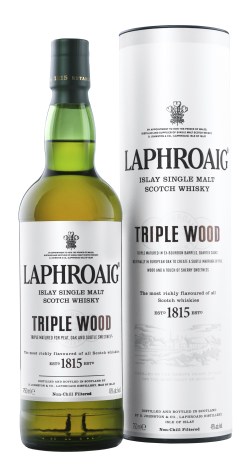
Triple Wood

Photo courtesy of Laphroaig.

Photo courtesy of Laphroaig.

As the name suggests, this expression of Laphroaig is triple-matured.  The first maturation takes place in ex-bourbon barrels.  After an undisclosed amount of aging (after all, this IS a non-age stated whisky), the liquid is moved to smaller quarter casks for its second maturation.  After some time, the whisky is transferred again to European oak casks that previously held Oloroso sherry.  This release is non-chill filtered and bottled at a hearty 48% abv.

The nose is full of rich smoked fruit, caramel and peat, with some oak in the background.  The fruity aromas make sort of reminds me of a sweeter, younger sibling to Laphroaig 15 year old.  Taste-wise, oak is a major player – just as it is in Laphroaig Quarter Cask – and shows up immediately on the entry.  Sweet tropical fruit and toffee provide sweetness and richness to the whisky.  But, this is Laphroaig, so that signature ashy smoke and brine is here as well, though that salty note is a bit subdued.  Vanilla bean and a touch of wine pop up towards the end of the mid-palate.  The finish is a little hot at first, but fades over a long time and leaves behind smoked tropical fruit.

Laphroaig distillery manager John Campbell has concocted a rich, sweet and smoky whisky with Triple Wood.  There’s great precision in the use of ex-sherry casks for this release.  The sweetness the sherry cask-maturation provides gives this whisky extra layers of complexity and overall enjoyability.  Highly recommended.

8.5/10

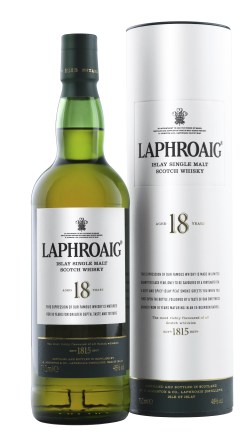
Laphroaig 18-Year-Old

Photo courtesy of Laphroaig.

Photo courtesy of Laphroaig.

The general rule of thumb is that peated whiskies lose their “peatiness” the longer they mature.  Laphroaig’s standard 10-year-old expression is a peaty slap in the face.  Let’s see what eight extra years of maturation does to the “smoky beast”.

On the nose is a bit of sweet, almost candy-like fresh fruit (honeydew melon and pineapple) and vanilla, alongside soft peat and honey.  Though it’s bottled at 48% abv, the entry is rather mellow.  Those saccharine fruit notes from the nose are also found on the palate.  Toffee lends a bit of richness (and sweetness) on top of smoky vanilla and just a touch of spiciness.  The peat comes across as a grassy note.  Some citrus (I’m torn between lemon peel and grapefruit) develops into the long, sweet and somewhat smoky finish.

Eighteen years in oak did mellow the peat Laphroaig is famous for.  Though this expression is still richly flavored, the peaty punch has changed from an knock-out uppercut to a strong right hook.  It still tastes like a Laphroaig whisky, just not as sweet or smoky.  Let’s call it refined.  I liked this whisky a lot the first time I tasted it.  I liked it even more upon further sampling.  Highly recommended, so long as you’re not expecting a giant peaty beast.

9/10
(Note: Review samples were provided by Laphroaig.)