Reviews

Russell’s Reserve Rye Whiskey Review

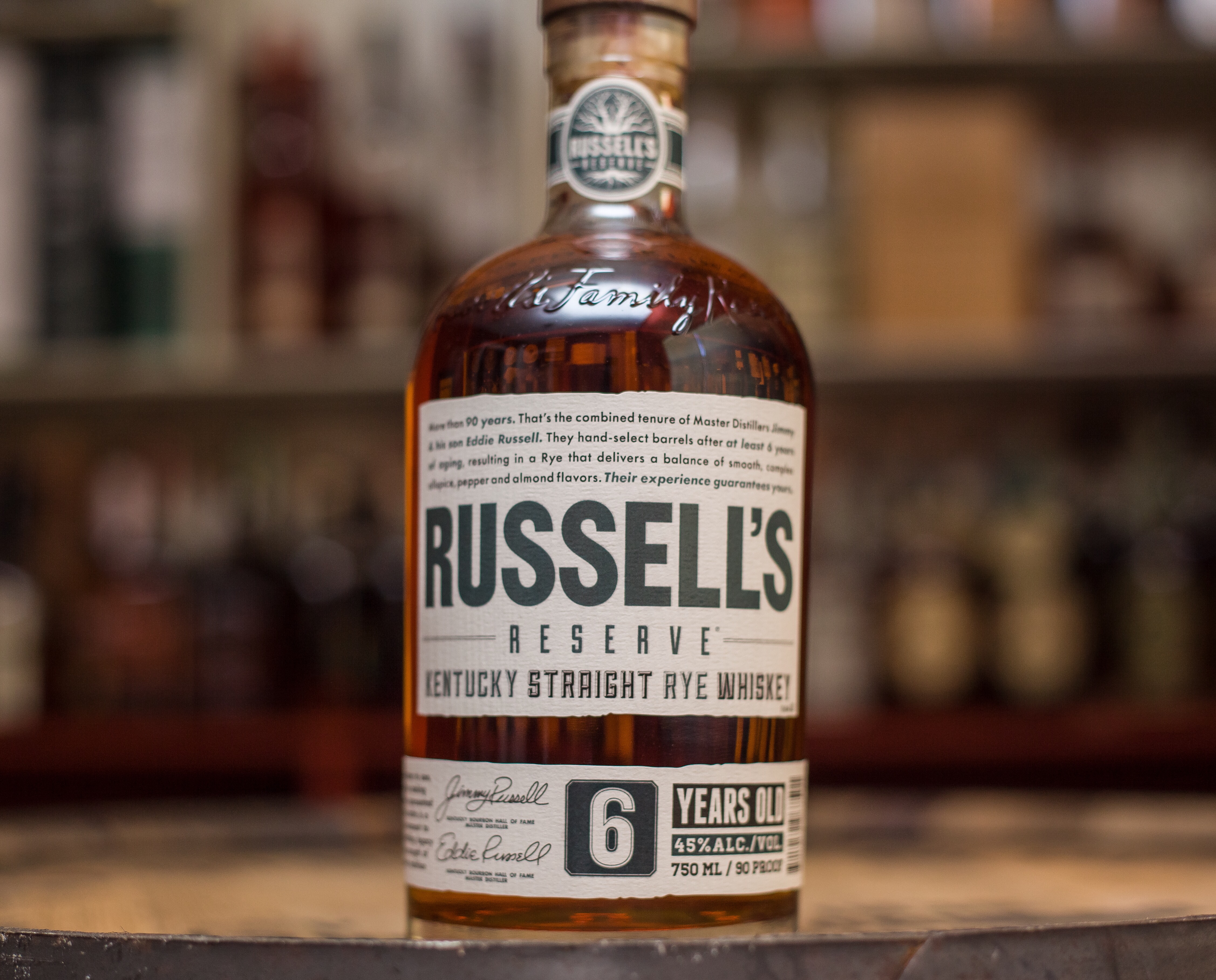
Russell’s Reserve’s new packaging puts the distillers’ name at the forefront.

I love bourbon, but sometimes I want something with a little more kick.  That’s when I reach for a glass of rye whiskey.  Lately, I find myself drinking more and more rye whiskey.  Whether it be something big and powerful like Pikesville Rye or something deeply complex like Sazerac 18-year-old Rye, there’s something to scratch my itch.  So when the folks at Russell’s Reserve sent over samples of their bourbons for me to try, they also included a bottle of their 6-year-old rye whiskey.  I was especially excited because I really like Wild Turkey’s 101 proof rye whiskey.

The nose is aromatic and absolutely lovely.  Spicy caramel, cloves, allspice, and  toasted rye bread dominate the nose.  After a little time in the glass, hints of dill and vanilla appear.  The nose seems fuller than Wild Turkey 101 proof rye, which is also fantastic.  In the taste department, rye spice hits your tongue sharply, but soon mellows out.  Waves of nutty toffee and baking spices develop over a bed of creamy vanilla.  The spice ramps up again for the long, warm finish.

Wild Turkey Master Distiller Jimmy Russell has stated in the past that he doesn’t release whiskies younger than six years old for any of his products.  He also said he thinks a rye whiskey peaks in flavor at six years of age.  Comparing this bottle of Russell’s Reserve Rye with Wild Turkey’s 101 proof rye, I find this one more “rye-forward.”  If we’re to believe Jimmy, and I have no reason not to, both whiskies are at least six years old.  Russell’s Reserve Rye seems to be a bit sharper and more complex in flavor and aroma, where Wild Turkey Rye has a flavor profile closer to a Wild Turkey bourbon.

This one’s a keeper.  It has everything I look for in a young rye whiskey.  The rye grain sharpness, baking spices and just enough sweetness.  I’ve only sipped this whiskey, and haven’t had a chance to mix into a cocktail.  I bet it’ll make a helluva sazerac.
8/10
(Note: A review sample was provided by the company behind this whisky free of charge.  The opinions written are my own.)

Russell’s Reserve Bourbon Review

As big of a Wild Turkey fan as I am, I can’t explain why I’ve never tried Russell’s Reserve until now.  I know, I know.  There’s no excuse.

Russell’s Reserve the premium brand from the Wild Turkey Distillery.  There’s a 10-year-old bourbon (which I’m writing about in this article), a single barrel bourbon, a six-year-old rye whiskey, and a single barrel rye whiskey.

The Russell in Russell’s Reserve refers to the two master distillers, Jimmy and his son Eddie Russell.  Jimmy’s been in the business for more than 60 years.  Eddie recently celebrated 35 years in the whiskey business.  I had the pleasure of meeting both bourbon legends at Tales of the Cocktail aboard the Wild Turkey bus.  It was an amazing experience and you want, you can read about it here.

Onto the whiskey.

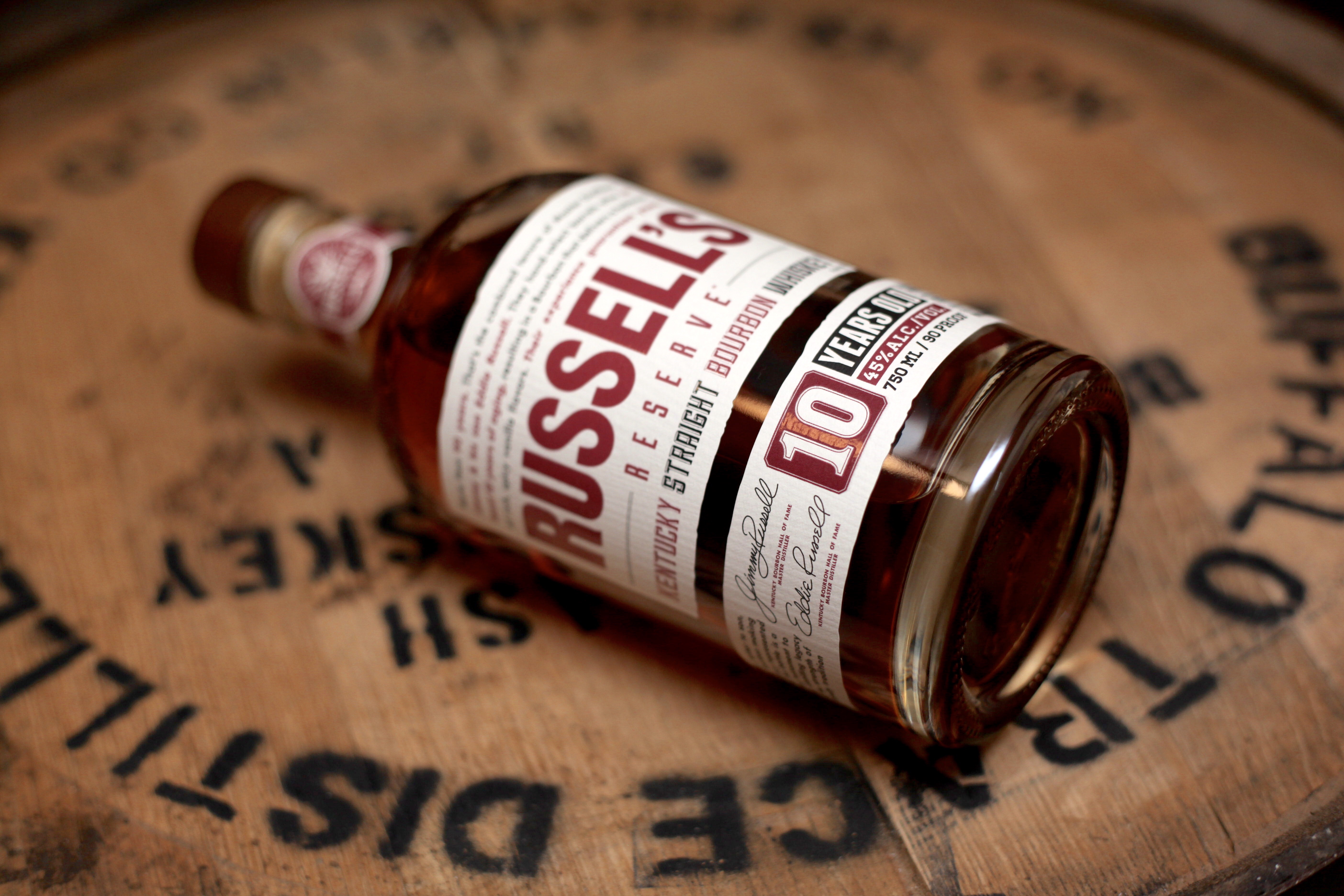
Russell’s Reserve 10-year-old bourbon is one of the few whiskies coming out of the Wild Turkey distillery with an age statement.  It’s a small batch bourbon, which just means there are less barrels blended in a batch of Russell’s Reserve compared to a batch of Wild Turkey.  Remember, the term “small batch” has no official meaning.

One thing I love about Wild Turkey 101 is the high proof.  It elevates the spicy profile of that bourbon beautifully.  I try my best not to judge a whiskey before I try it.  I really do.  But when I saw the lower-than-expected 90 proof on this label I inadvertently formed a slightly negative opinion.  “Where’s the 101 proof?” I asked.  See, Wild Turkey 81 tastes like a watered down, neutered version of Wild Turkey 101.  It has no bite.  My mind sort of went to that line of thinking when I read the label for Russell’s Reserve 10-year.  Boy was I wrong.

Ten years in a barrel is pure magic for this bourbon.  The nose is rich and spicy, providing waves of cooked vanilla bean and light brown sugar.  Hints of anise, toasted rye bread and oak round out the aromatic nose.  The palate is equally inviting, with a fuller-than-expected mouthfeel.  Big bourbon caramel and vanilla notes are present.  However, it’s not as sweet as a standard bourbon, and that’s due to the high rye content in the mash bill.  Cardamom and dried herbs give way to nutmeg, cinnamon sticks and oak.  The medium finish leaves a refreshing mint note.

Russell’s Reserve 10-year is a very enjoyable bourbon.  It has loads of flavor and a beautiful nose, but something is missing here.  The “bite” I associate with Wild Turkey bourbon isn’t really found here.  Instead it’s one of the smoother bourbons coming from the Wild Turkey distillery.  I assume lots of people like that word when describing a whiskey, as it’s found in just about every bourbon advertisement I come across.   Personally, I want the bourbon coming from the Wild Turkey Distillery to have “bite” and it’s slightly lacking here.  Don’t conflate “bite” with character.  This bourbon has plenty of that.  Russell’s Reserve is a well-rounded, thoroughly flavorful bourbon that should please just about anybody who drinks it.

8.5/10
(Note: A review sample was provided by the company behind this whisky free of charge.  The opinions written are my own.)

Buffalo Trace Experimental Collection Review – Infrared Light

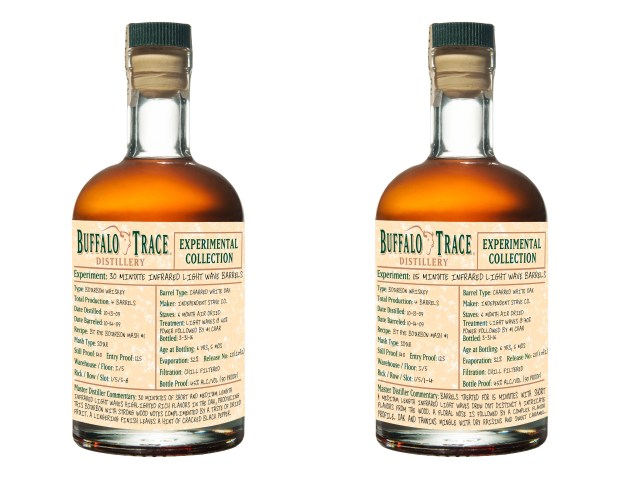
Photo courtesy of Buffalo Trace

Photo courtesy of Buffalo Trace

In what may be it’s most science fiction-like experiment yet, Buffalo Trace Distillery’s newest addition to their Experiment Collection sees the company using infrared light waves.  Just before the eight barrels used were charred, they were exposed to infrared light.  The press release explains the process:

Working with barrel cooper Independent Stave Company in 2009, eight special barrels were constructed. All eight first underwent the same process as standard Buffalo Trace barrels, staves were open air seasoned for six months before being made into barrels.

Then, the barrels were divided into two groups and subjected to two different levels of infrared light waves.  The first group of four barrels underwent 15 minutes of both short wave and medium wave frequency at 70% power.  The second group of four barrels was subjected to 30 minutes of both short wave and medium wave frequency at 60% power. The barrels were then given a quick #1 (or 15 seconds) char, before finally being filled with Buffalo Trace’s Bourbon Mash #1.

The whiskey matured for six and a half years in those barrels and then were bottled at 90 proof.  Keeping in line with the rest of the Experimental Collection, both the 15 minute and 30 minute are available separately in 375ml bottles for about $46.

15 MINUTE INFRARED LIGHT WAVE BARREL

The nose here carries lots of butterscotch, vanilla and sweet oak.  It’s one of the lighter noses I’ve encountered in a Buffalo Trace bourbon.  After a few moments in the glass, some red fruit aromas develop.  Taste-wise, oak is a tad more prevalent than the nose suggests.  The mouthfeel is on the thin side.  Lots of vanilla and oak spice prevail over the sweet traditional bourbon caramel.  The finish is full of vanilla ice cream and a touch of nutmeg.  Not bad.  Not bad at all.  It’s a young, solid bourbon that has some characteristics of older whiskey.  But, nothing special here.

30 MINUTE INFRARED LIGHT WAVE BARREL

There’s a lot more oak here compared to the 15 minute experiment.  This bed of toasted oak provides a foundation, followed by maraschino cherries, vanilla extract, dark caramel, and light floral notes.  The entry here is an initial hit of cinnamon spice, followed by tons of oak.  It’s mouth drying from the start.  Sweetness is provided by caramel candy and maple syrup.  With so much oak in the nose and palate, it comes as no surprise that the finish is short and dry.  Not a fan of this one.  Where things mostly came together for the 15 minute infrared experiment, this one is an oaky bust.

While I am always thoroughly curious with Buffalo Trace Distillery’s experiments, I don’t always love them.  This is one of those rare times.   These aren’t rot-gut bourbons by any means.  They are just okay, and that in itself is acceptable given the circumstances of experimentation.  Not all experimental whiskies are going to be phenomenal.  It’s just the nature of the game.

(Note:  A review sample was provided by the company behind these whiskies free of charge.  The opinions written are my own.)