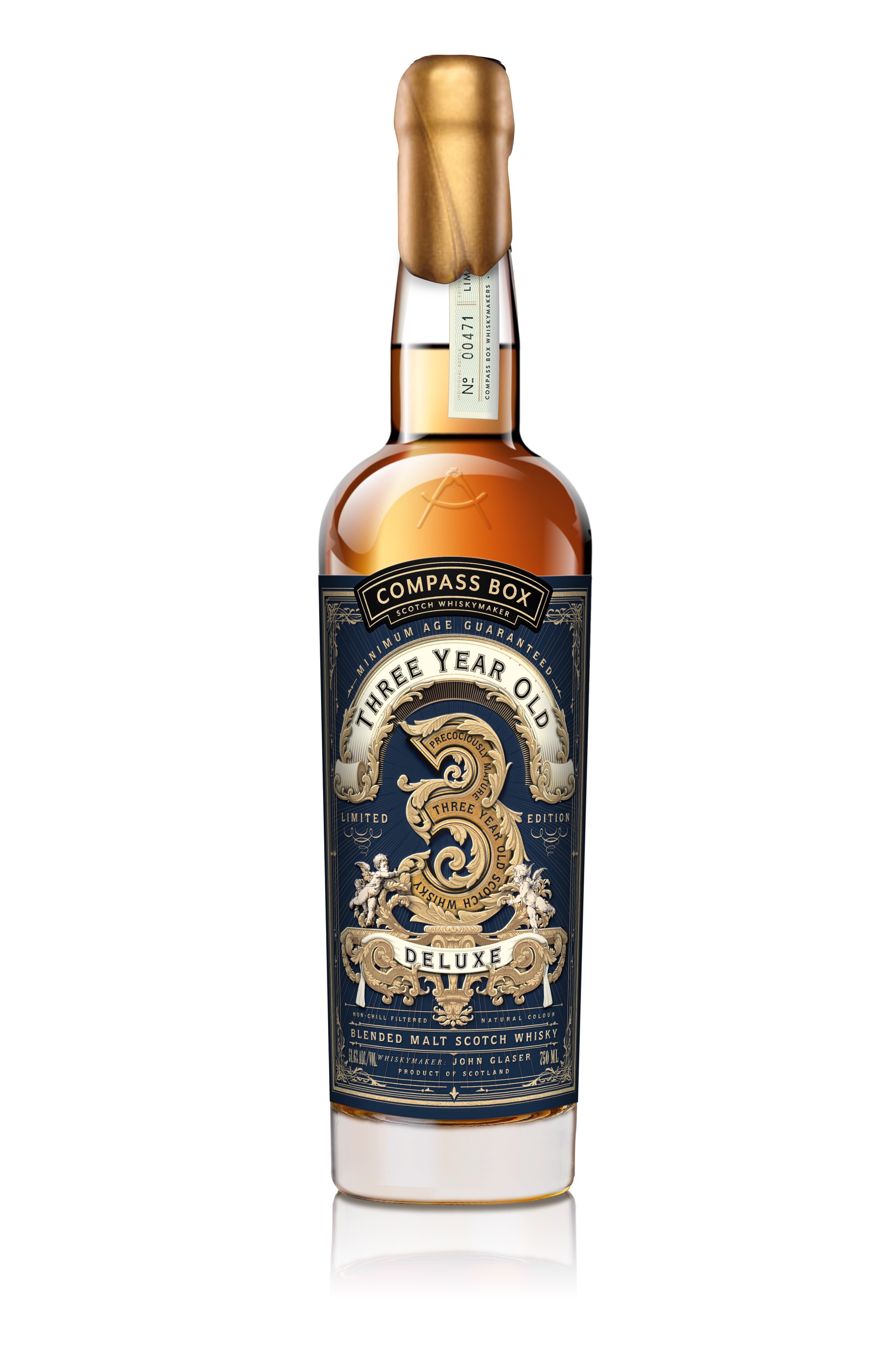
Three Year Old Deluxe Blended Malt Scotch Review


I picture a person who knows little about Scotch roaming the whisky aisle at their favorite shop.  This person scans the shelf and comes across a whisky called “Three Year Old Deluxe.”  I can’t imagine the expression on the person’s face when he/she looks down and discovers the $300 price tag.  “$300 for a 3-year-old whisky?!?”

Yep, $300 for a 3-year-old whisky.  That’s what Compass Box suggests the price be set at.  Nuts right?  Actually, the price is just where it needs to be.  Obviously, it’s no ordinary 3-year-old whisky.  Only 0.4% of this whisky is three years old.  The remaining 99.6% is made of whisky MUCH older than that.  Compass Box’s Three Year Old Deluxe is turning an old whisky regulation on its head – whisky makers can only disclose the youngest component whisky in their blend.  Compass Box’s head honcho, John Glaser, wants to tell you what’s in his whisky, and even campaigned to get this law changed.  

Glaser consulted his lawyers and received some advice.  In a statement, Glaser said “While we must not actively promote the ages of the components used in our blends, we can provide information when we are asked for it by interested consumers.”

So put simply, ask and you shall receive.  I did just that, but I’ve been asked not to publicly release the information.  According to an interview I had with Glaser recently, my posting the information could be perceived as promoting, which could prompt a complaint by an Scotch Whisky Association member.

Onto the whisky.  Three Year Old Deluxe is made of whiskies from “peaty malt whisky distilled on the Isle of Skye” (read: Talisker) and Clynelish, and bottled at 51.6% abv.  The aromatic nose features spiced tree fruit, clove, sherried malt and some vanilla bean, along with a hint of white pepper.  Taste-wise, the signature waxy fruitiness of Clynelish comes through in a big way.  First, there’s a richness and sweetness from the older components.  The minuscule amount of 3-year-old Clynelish adds a bit of vibrancy.  A bit of clove, vanilla creme brûlée, and spice lead to a whiff of smoke on the back end.  The medium-length finish is a touch spicy, sweet and smoky.

Fantastic stuff here.  The blending of Clynelish and Talisker make for a rich, sweet, fruity and somewhat smoky whisky.  If that flavor combination appeals to you, and you have a $300 to spend on a whisky, call your favorite store now to reserve a bottle.  There’s not a lot of this stuff to go around – only about 3,200 bottles are available worldwide.  Three Year Old Deluxe makes the shortlist as one of my favorite whiskies this year.  9.5/10

Thanks to Compass Box for the sample!  As always, all thoughts and opinions are my own.

A Conversation with John Glaser of Compass Box Whisky

Compass Box Whisky founder John Glaser (photo credit: Compass Box Whisky)

Compass Box Whisky founder John Glaser (photo credit: Compass Box Whisky)

I had a chance to chat with Compass Box Whisky’s founder John Glaser, who is in the U.S. for WhiskyFest in New York.  During the course of our conversation we covered a variety of topics, including transparency in the whisky business, his company’s two latest releases (3 Year Old Deluxe & Spice Tree Extravaganza), and more.  You can hear the entire interview below.

If you’re curious about the ages of the component whiskies of their newest releases, contact them here.  Also, starting today, Compass Box will reveal the ages of their entire Signature range and Great King St. range via their website.

Expect my tasting notes for 3 Year Old Deluxe and Spice Tree Extravaganza later this week.  Both expressions launch today in the U.S.


Jim Beam Double Oak Bourbon Review

Photo courtesy: Jim Beam


Barrel finishing is not a new idea in the Scotch whisky world.  On this side of the pond, it used to not be common to see that flavoring technique utilized.  In recent years, however, more and more bourbons and rye whiskies are being “barrel finished.”  That basically means that after a whiskey has matured in a new oak barrel, it’s transferred to another barrel for a shorter, secondary maturation.  Wine casks such as port and sherry are the most common.  

Barrel finishing is nothing new for Jim Beam.  At the top of their product lineup sits the pricey Jim Beam Distiller’s Masterpiece, an “older  Jim Beam finished in Pedro Ximenez Sherry casks, which has received generally positive reviews.  Now, the bourbon juggernaut has unveiled another barrel-finished bourbon, this time priced for the general whiskey-buying population: Jim Beam Double Oak.  

This new expression starts with four year old Jim Beam bourbon.  The whiskey is then transferred to a new, charred oak cask for an unspecified amount of time.  This process is meant to impart more oak flavor to the standard Jim Beam flavor profile.  Bottled at 86 proof and available for a suggested price of $22, Jim Beam Double Oak sits firmly between the White Label and Black Label.  

For the most part, this new expression is exactly what you’d expect.  The nose features a ton of vanilla and oak thanks to the secondary maturation in new charred barrels.  Some light caramel, cornbread and a familiar nutty note round out the nose.  Taste wise, it’s the standard Jim Beam profile of caramel, vanilla, and sweet corn with the added bonus of oak spice.  The caramel note featured here is a bit darker… burnt almost.  The palate turns slightly dry going into the slightly spicy and sweet finish.

Compared to Jim Beam White Label, Double Oak is much bolder.  I think I like it more than Jim Beam Black Label.  While the Black Label has slightly more complexity, this new expression excites the palate, making it more fun to drink.  For $22, I’ll be keeping a bottle handy at the house. 8/10

Thanks to Jim Beam for the sample.  As always, all thoughts and opinions are my own.